Physical Address
304 North Cardinal St.
Dorchester Center, MA 02124
Physical Address
304 North Cardinal St.
Dorchester Center, MA 02124

Parlays look exciting because they promise something simple and powerful: turn a small stake into a big payout. You stack a few predictions together, and suddenly the potential return multiplies. It feels efficient. It feels smart. It feels like you’ve found leverage.
But most beginners misunderstand what’s actually happening behind that big number. The payout grows fast, yes but so does the risk. Every extra leg doesn’t just increase reward, it compounds probability. That’s the part most bettors never calculate.
In this guide, you’ll see exactly how parlay odds are calculated, why the math works the way it does, and why sportsbooks highlight these bets so prominently. And if you want to test the numbers yourself while reading, you can plug any example into the BetBuzz24 Betting Parlay Calculator to see the real payout instantly.
A parlay is one single bet made up of multiple selections. It looks like several picks, but once you confirm it, they are all locked into one ticket.
This is the rule that matters. All selections have to win for the bet to cash. If you hit four out of five picks, you still lose the entire parlay. There is no partial payout.
So if you’re asking, what really happens if one leg loses? The answer is simple. The whole ticket is graded as a loss.
The sportsbook is only paying you if everything goes perfectly. Because the probability shrinks with every added leg, the payout grows. Higher risk, higher potential return.
If a selection pushes, most sportsbooks remove that leg and recalculate the odds. Your parlay stays alive, but the payout drops because one multiplier is gone.
Yes. You can combine:
No matter the mix, the rule stays the same. Every active leg must win.
Two picks doesn’t sound extreme. It feels manageable. But the risk isn’t added, it’s multiplied. Even strong selections reduce your overall probability when combined.
A two-leg parlay is not reckless. But it is mathematically different from placing two separate bets. Understanding that difference is where smarter betting starts.
Parlay odds are not random. They follow a simple formula. Once you understand it, the big payout numbers make complete sense.
If you’re betting in American odds like -110 or +150, the cleanest way to calculate a parlay manually is to convert everything into decimal format first.
Decimal odds show the total return per $1 staked. That’s why they’re easier to multiply.
Yes, you should convert first. Trying to multiply American odds directly makes the math messy.
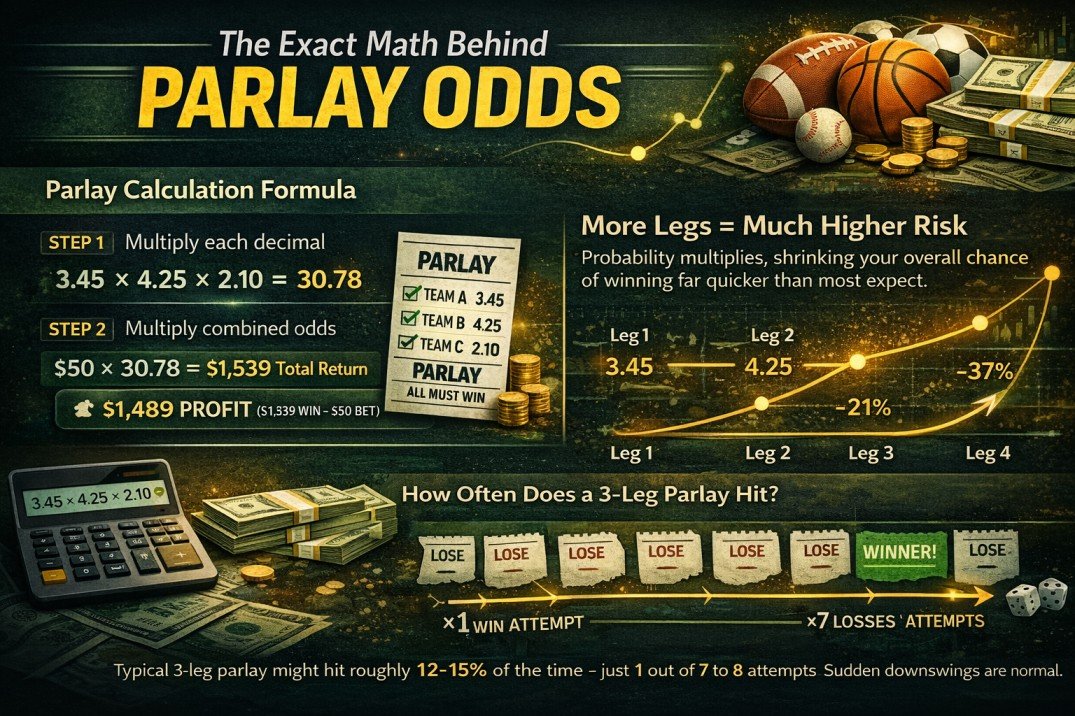
Let’s say you have two -110 picks.
1.91 × 1.91 = 3.65
That 3.65 is your combined decimal price.
This is how parlay odds are calculated manually. Every additional leg gets multiplied into the total.
Add a third 1.91 leg:
3.65 × 1.91 = 6.97
Notice what’s happening. The payout grows fast. But so does the difficulty of winning.
If you stake $100 at 3.65 decimal odds:
$100 × 3.65 = $365 total return
Total return includes your original stake.
Profit is different.
$365 − $100 = $265 profit
Many beginners confuse payout and profit. Payout includes your stake. Profit is what you actually gain.
Each leg has its own implied probability. When you combine them, those probabilities multiply just like the odds do.
If each pick has roughly a 52% chance of winning, combining two doesn’t give you 104%. It gives you:
0.52 × 0.52 = 27%
That’s why even small parlays become hard to hit. The math compounds against you.
You can calculate everything manually. But converting odds, multiplying decimals, separating profit from return, and estimating implied probability takes time.
A good parlay calculator does this instantly. It shows total payout, profit, and often implied probability in one place. If you want to test different combinations quickly, you can use the BetBuzz24 Betting Parlay Calculator to see the real numbers without doing the math by hand.
Understanding the formula gives you control. Using the calculator gives you speed.
This is where most new bettors get surprised.
Adding one more leg doesn’t increase risk slightly. It compounds it.
Every time you add a selection, you are multiplying probability, not stacking it. That single extra pick changes the entire math of the ticket.
Imagine each bet has a true 50% chance of winning.
Two-leg parlay:
0.50 × 0.50 = 25% chance
Three-leg parlay:
0.50 × 0.50 × 0.50 = 12.5%
Five-leg parlay:
0.50⁵ = 3.1%
That’s the compounding effect.
The payout grows aggressively, but your true chance of winning drops much faster than most beginners expect.
Going from three legs to five legs might feel like “just two more picks.” But mathematically, you’re cutting your probability by more than half again.
That’s why risk increases so sharply. It’s not linear. It’s exponential.
Ten-leg parlays look incredible on the bet slip. The potential payout can be 50x, 100x, sometimes more.
But let’s stay realistic.
If each leg had even a strong 55% win probability:
0.55¹⁰ ≈ 0.25%
That’s roughly 1 win in 400 attempts.
The fantasy is the payout. The math is the probability.
Two-leg parlays can still be reasonable if each selection has value. The probability is reduced, but not crushed.
Once you move into five, six, seven legs, the win rate becomes extremely low unless you have a genuine edge on every selection.
The worst-case risk is simple: you can lose repeatedly, even if your individual picks are solid on their own.
Adding one more leg always increases payout. But it increases volatility and reduces true probability even faster.
Understanding that trade-off is the difference between betting for entertainment and betting with awareness.
Variance is simply how much your results swing up and down.
With single bets, swings are smaller. You win some, you lose some. The rhythm feels steady.
With parlays, swings are extreme.
Because the true probability is lower, you can go on long losing streaks even if your picks are reasonable on their own. That doesn’t automatically mean you’re betting badly. It means the structure of the bet is volatile.
A three-leg parlay made of standard -110 type selections might have a true win probability somewhere around 12% to 15%, depending on pricing.
That means you could expect roughly one win in every 7 to 8 attempts.
But variance doesn’t space wins evenly. You might hit one quickly. Or you might miss ten in a row before one lands.
Both are mathematically possible.
If your true hit rate is 15%, long droughts are normal. Losing 8, 10, even 12 in a row isn’t shocking. It’s built into the math.
Beginners often overestimate how frequently parlays should win. A three-leg ticket feels like it should cash regularly. But probability doesn’t work on feeling.
Lower probability means streakier outcomes.
When you lose multiple parlays in a row, it feels personal. It feels like you’re always “one leg short.” That emotional pressure can push bettors to:
That’s where variance becomes dangerous.
Because results swing more violently, your stake size must adjust. Risking too much per parlay can drain a bankroll quickly during a normal losing stretch.
Variance is not a sign that parlays are broken. It’s a reminder that lower probability bets require stronger discipline.
If you understand that a three-leg parlay won’t hit often, and you size your bets accordingly, the volatility becomes manageable instead of stressful.
There’s no conspiracy here. Sportsbooks promote parlays for one simple reason: they are good business.
When you combine multiple bets into one ticket, the margin doesn’t just stay the same. It compounds.
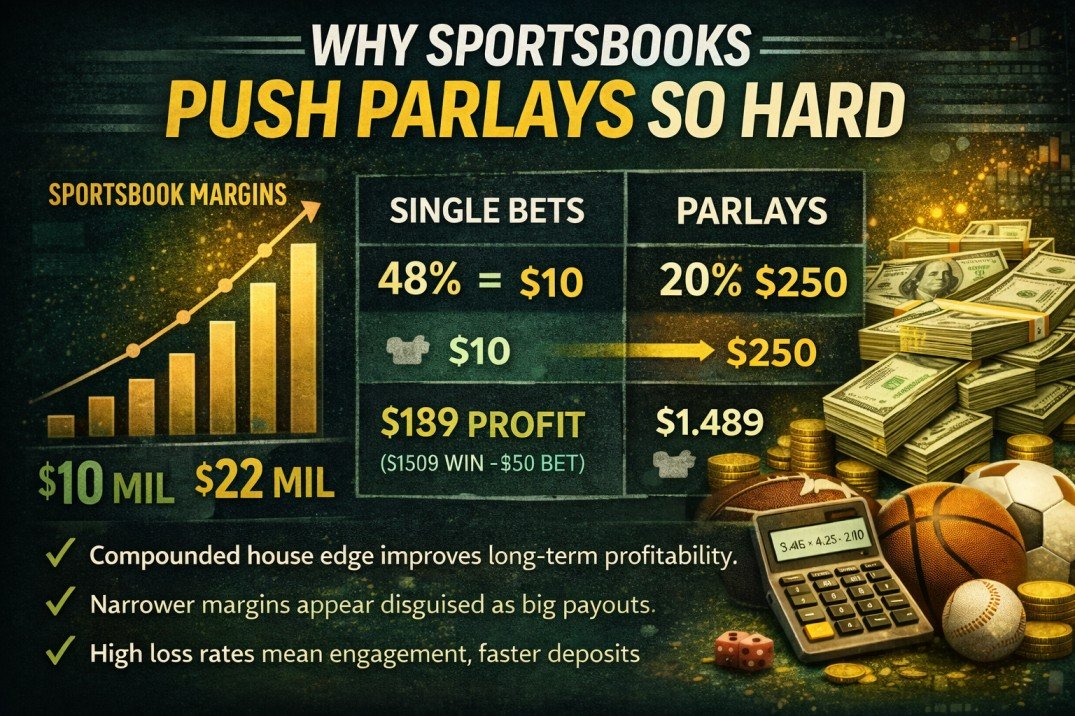
Every individual bet already includes a small built-in edge for the sportsbook. When you multiply selections together, that margin effectively stacks with each leg.
That means the house edge on a five-leg parlay is generally higher than on a single straight bet.
So yes, books typically make more money from parlays over time. Not because they’re unfair, but because the structure increases volatility and reduces true win probability.
Sportsbooks like DraftKings and FanDuel heavily promote Same Game Parlays because they increase engagement and pricing flexibility.
Same Game Parlays allow books to:
They’re interactive. They feel personalised. That drives volume. Correlated betting and pricing adjustments are explained further here.
Parlay odds are mathematically calculated. But that doesn’t mean they’re priced the same way as straight bets.
When outcomes are correlated, meaning one result makes another more likely, sportsbooks adjust the pricing to reflect that relationship. You can’t usually exploit obvious correlations because the system already accounts for them.
You’ll often see “Parlay Insurance” or “Profit Boost” offers. These aren’t random. They’re designed to make parlays feel safer or more valuable.
Boosts can improve value in certain cases, but they don’t change the underlying probability. The bet is still all-or-nothing.
Yes. Some sportsbooks cap maximum parlay payouts, especially on large long-shot combinations. This protects them from extreme liability on unlikely outcomes.
The key takeaway isn’t that parlays are bad. It’s that sportsbooks promote them because they’re high-margin, high-engagement products.
If you understand that, you can approach them with awareness instead of emotion.
Same Game Parlays, often called SGPs, allow you to combine multiple bets from the same match into one ticket. Instead of picking games across different leagues, you stack outcomes from a single event. For example, a team to win, the total points to go over, and a specific player to score.
It feels powerful because everything unfolds in one game. One story. One sweat.
Because they are priced differently.
In a regular multi-game parlay, each leg is usually independent. In a Same Game Parlay, many outcomes are connected. If one happens, another becomes more likely.
Sportsbooks don’t ignore that connection. They adjust the pricing to account for it.
Correlated legs are selections where one outcome directly influences another.
For example:
These outcomes are not independent. If one hits, the probability of the other shifts.
That’s correlation.
Many beginners assume that stacking correlated picks increases their edge. In reality, sportsbooks already factor correlation into the combined odds.
The payout might look slightly lower than you expect. That’s not random. It’s adjusted pricing.
You’re not multiplying raw probabilities. You’re multiplying bookmaker-adjusted numbers.
Yes. Most sportsbooks allow player props, team totals, spreads, moneylines, and more within an SGP. That flexibility is part of the appeal.
Teasers are different. They allow you to adjust point spreads in your favour, usually at the cost of lower payout. Same Game Parlays increase payout through combination, but maintain all-or-nothing risk.
Neither is automatically better. They simply manage risk and reward differently.
The key idea is this: Same Game Parlays feel smarter because everything is connected. But connection does not mean free edge. The pricing already reflects the relationship between selections.
This is where it helps to separate emotion from math.
Parlays are exciting. The potential payout is what draws people in. Turning $20 into $300 feels efficient. It feels like you’re maximising value.
But entertainment and long-term return are not the same thing.
Parlays are high-variance bets. They pay more because they win less often. That structure naturally increases volatility and, in most cases, the effective house edge.
Over a large sample size, parlays are generally harder to beat consistently than single straight bets. That doesn’t mean they can’t win. It means the expected return is usually lower unless you have a genuine pricing edge on every leg.
So are parlays profitable long term? For most bettors, no. They are more volatile and less consistent than straight betting.
Parlays can make sense when:
They are also reasonable if you treat them as high-risk, high-reward shots rather than a core strategy.
Parlays are not ideal if your goal is steady bankroll growth. They are also risky if you are increasing stake size to “speed up” profits.
Because probability compounds, even solid individual picks can fail together more often than you expect.
If you choose to bet parlays, keeping stake size smaller than your typical straight bet is a disciplined approach. High variance requires tighter bankroll control.
Instead of risking 3–5% of your bankroll, many experienced bettors would reduce that for parlays because losing streaks are normal, not unusual.
Most sharp bettors focus on finding small edges and repeating them over time. Parlays magnify volatility, which makes consistent edge exploitation harder.
Can you beat parlays? In theory, yes, if every leg carries positive expected value. In practice, that’s difficult to sustain across multiple selections.
Parlays are not inherently bad. They are simply structured differently.
If you understand that they prioritise payout potential over consistency, you can decide whether they fit your strategy instead of chasing them for quick results.
Hedging means placing a new bet on the opposite outcome to reduce risk and lock in some profit.
You’re not cancelling your original parlay. You’re balancing it.
This usually comes up when you’ve hit several legs and only one remains.
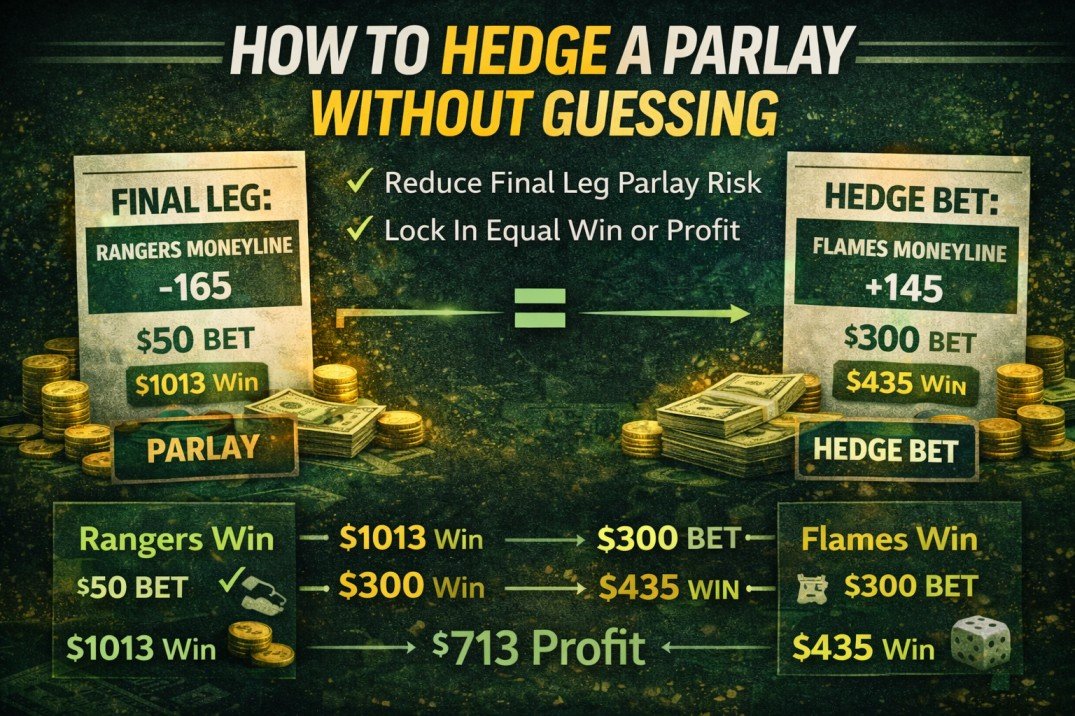
Let’s say:
Now you have a decision. Do you let it ride for the full payout, or do you secure guaranteed money?
If the final team is -150, you could bet the opposite side to guarantee profit no matter what happens.
To calculate a full hedge:
Hedge Amount = Potential Profit ÷ Opposing Decimal Odds
That tells you how much to bet on the opposite outcome to lock in roughly equal profit either way.
Before hedging, it helps to know your exact payout and profit breakdown. That’s where the BetBuzz24 Betting Parlay Calculator becomes useful. Once you know the total return and profit precisely, you can calculate the hedge amount accurately instead of guessing.
Yes.
If you hedge fully, you are sacrificing maximum upside in exchange for certainty. You trade a potential $950 profit for a smaller guaranteed amount.
It reduces profit ceiling, but it also reduces emotional pressure.
Hedging can make sense when:
It’s a risk management decision, not a math trick.
Letting it ride can make sense if:
Many professional bettors don’t automatically hedge. If they believe the original bet has positive expected value, they allow variance to play out.
Live betting adds flexibility. If your final leg is in play, you can wait for better in-game odds to hedge at a more favourable price.
But live markets move fast. Emotional decisions are common here. Always calculate before clicking.
Technically yes, but it becomes complex. Most hedging scenarios focus on the final leg because that’s where the payout is defined and the math is cleaner.
Hedging isn’t about fear. It’s about control.
If you understand your payout, your true risk, and your bankroll position, you can decide whether certainty or upside fits your strategy.
Parlays change how you should think about stake size.
Because the probability of winning is lower and variance is higher, your bankroll strategy needs to be tighter than it would be for straight bets.
A common guideline in sports betting is risking around 1% to 3% of your total bankroll per bet.
With parlays, leaning closer to 1% is usually safer.
Why? Because losing streaks are normal. If your true hit rate is 10–15%, you should expect multiple consecutive losses. Smaller stakes protect you during those stretches.
Not necessarily. But it depends on volatility.
If you’re betting mostly single plays with steady probability, 2% might be reasonable. If you’re betting multi-leg parlays with low hit rates, 2% to 3% can drain a bankroll quickly during a cold run.
The higher the variance, the more conservative you should be.
The danger isn’t just losing one bet. It’s losing five, seven, or ten in a row. When your stake size is too aggressive, normal variance feels catastrophic.
That’s when bettors start:
That spiral usually starts with oversized risk.
Parlays are high-volatility bets. That means discipline matters more than confidence.
Even if your picks are sharp, compounding probability makes consistent wins rare. You must structure your bankroll around that reality.
Generally, no.
Parlays are better suited for controlled, smaller-stake plays with higher upside potential. Straight bets are usually more stable for long-term growth because they allow you to compound small edges more consistently.
That doesn’t mean you should never bet parlays. It means you should treat them as high-variance tools, not core growth engines.
If your goal is steady progress, size your parlays smaller than your straight bets and let probability work over time instead of trying to force it.
Parlay odds are calculated by converting each selection into decimal format and multiplying them together. The final decimal number is then multiplied by your stake to determine total return, while profit equals total return minus your original bet.
If one leg of a standard parlay loses, the entire ticket loses. All selections must win for the bet to cash, which is why payouts are higher than single straight bets.
Each additional leg multiplies probability rather than adding it. That means your overall chance of winning drops exponentially, even if every individual selection looks strong on its own.
A typical three-leg parlay made with standard sportsbook pricing might win roughly 12 to 15 percent of the time. Losing streaks are common because probability compounds quickly.
Sportsbooks promote parlays because compounded margins and lower win probabilities generally increase long-term profitability. Same Game Parlays also increase engagement and allow more flexible pricing adjustments.
A Same Game Parlay allows multiple outcomes from a single event to be combined into one bet. All selections must win, and pricing adjusts to reflect correlation between outcomes.
Parlay variance refers to large swings in results caused by low combined probability. Because win rates are smaller, extended losing streaks are mathematically normal.
Yes. You can place a bet on the opposite side of the final leg to reduce risk or lock in guaranteed profit before the parlay settles.
For most bettors, parlays are harder to profit from long term because compounded probability increases volatility and often results in a higher effective house edge.
Parlays are high-volatility bets and generally less stable for steady bankroll growth. They are better suited for smaller, controlled stakes rather than long-term accumulation strategies.