Physical Address
304 North Cardinal St.
Dorchester Center, MA 02124
Physical Address
304 North Cardinal St.
Dorchester Center, MA 02124

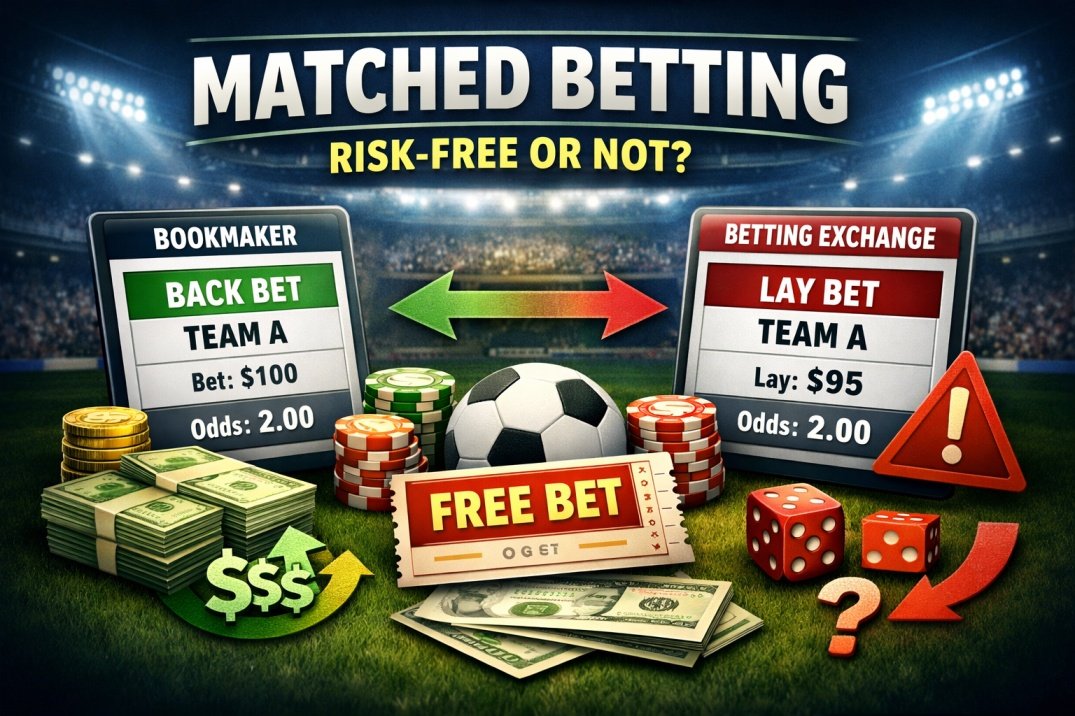
Matched betting is often promoted as a risk-free way to make money from betting.
At first glance, it sounds simple. Place two bets, cover all outcomes, and secure a guaranteed profit. It’s marketed as a system that removes uncertainty from betting altogether.
But in reality, it’s not as straightforward as it seems.
While the concept is structured to reduce risk, the actual execution involves multiple steps, calculations, and conditions where mistakes can happen. And that’s where the idea of “risk-free” starts to break down.
Matched betting can minimise risk, but it doesn’t eliminate it completely.
Matched betting works by placing two opposite bets:
The idea is to cover all possible outcomes so the result of the event doesn’t affect your overall position.
Let’s say:
Now two outcomes are possible:
Net result: about $5 profit
Net result: about $5 profit
In both cases, the outcome is nearly the same, a small and controlled profit.
In real situations, the numbers vary slightly because of exchange fees, odds differences, and how accurately the stakes are calculated.
Most people think matched betting makes money from the bet itself.
It doesn’t.
The real profit comes from how free bets and promotions are structured.
When you receive a free bet, the stake is usually not returned. This is where many beginners misunderstand the profit.
If this were a normal bet, profit would be $100.
But with a free bet, only the winnings are paid.
So:
Now you place a lay bet on the exchange to cover the outcome.
After adjusting for:
👉 Final profit typically comes to around $60–$80
Because:
This process is called “conversion”, turning a free bet into real, withdrawable cash.
At first, it seems like bookmakers are giving away free money. But there’s a clear business reason behind it.
In reality, many users:
👉 which leads to losses over time
Matched betting works because it follows a structured approach.
But the system itself is profitable for bookmakers because:
most people don’t execute it with precision or discipline.
Matched betting is often described as risk-free, but that depends on how you define “risk-free”.
On paper, matched betting is designed to remove risk.
By placing a back bet and a lay bet correctly, you cover all possible outcomes. If everything is calculated perfectly and executed without error, the result is a small, predictable profit.
In this ideal scenario, the outcome of the event doesn’t matter.
In practice, things are not always perfect.
This is where risk starts to appear.
Common issues include:
You calculate your lay stake based on odds of 2.00, but by the time you place the bet, the odds move to 2.10.
That small difference can turn a guaranteed profit into a loss if not adjusted correctly.
Matched betting is structured to reduce risk, but it still depends on accurate execution.
Matched betting is low-risk, but not zero-risk in real execution.
Matched betting is often presented as simple and low-risk, but there are a few practical limitations that are rarely explained clearly.
These don’t always show up immediately, which is why many people only realise them later.
One of the biggest limitations is account restriction.
Bookmakers monitor user behaviour. If they detect patterns that look like matched betting, they may:
This directly affects your ability to continue making profit.
Over time, this becomes one of the main reasons why matched betting slows down.
Matched betting tends to follow a clear pattern:
This is where most of the profit comes from.
Signup offers and free bets can generate relatively higher returns in a short period.
Once initial offers are used, you rely on smaller promotions.
Profits become less frequent and lower in value.
As accounts get restricted, opportunities become very limited.
At this stage, continuing becomes difficult without new accounts or workarounds.
This progression is rarely explained, but it’s a key part of understanding the long-term reality.
Matched betting is not passive income.
It requires:
For many people, the time and effort involved becomes significant compared to the profit.
Matched betting can work, especially in the early stages.
But over time, restrictions, reduced offers, and effort required make it less straightforward than it initially appears.
One of the biggest misconceptions about matched betting is income potential.
While it can generate profit, the earnings are limited and follow a clear pattern.
This is where most of the money is made.
Using signup offers and free bets, a typical user can earn around $300 to $800 over a short period.
These profits come from:
Once these are used, the easy opportunities are mostly gone.
After the initial phase, earnings drop significantly.
You rely on smaller promotions and reload offers, which usually generate around $50 to $200 per month, depending on time, effort, and available offers.
At this stage:
Matched betting is not a scalable income source.
It works best as a short-term opportunity, not a long-term income strategy.
Matched betting is not a scam, and it can generate real profit when done correctly.
At the same time, it’s not risk-free, and it’s not as simple as it’s often presented. The process requires accuracy, discipline, and an understanding of how offers and odds work.
For beginners, it can be a useful way to take advantage of signup offers and make some initial profit. But over time, restrictions, reduced offers, and the effort involved make it less effective.
In practical terms, it’s a limited opportunity rather than a long-term strategy.
Matched betting can reduce risk significantly, but it is not completely risk-free and becomes less profitable over time.