Physical Address
304 North Cardinal St.
Dorchester Center, MA 02124
Physical Address
304 North Cardinal St.
Dorchester Center, MA 02124

Losing streaks that feel statistically impossible. Near-misses that look deliberate. A big win followed by losses so fast it feels like the game “took it back.” It’s no surprise many players start to suspect there’s some kind of hidden control behind the scenes.
Whether you’re a beginner about to try slots or a regular player who found a game that seems too good to be true, the real concern is the same: do you actually have a fair chance, or is the outcome already stacked against you?
Online slots at licensed casinos are random, not rigged for individual players, because results are generated by independently tested random number generators (RNGs). However, they are designed with a built-in house edge, meaning the casino profits over time even though real wins do happen. On unlicensed or poorly regulated sites, fairness may not be guaranteed.
This guide gives a clear, honest explanation of how online slots really work, why they can feel manipulated even when they aren’t, and how to tell the difference between a fair game and a risky one, without technical jargon or casino marketing spin.
Licensed online slots are random, not rigged for individual players. They use independently tested Random Number Generators (RNGs), which produce unpredictable results on every spin.
Unlicensed or offshore sites can manipulate games or use uncertified software, so fairness is not guaranteed.
Casinos still profit because every slot has a built-in house edge. Players can win in the short term, but the design ensures the casino makes money over time.
Not all slots are equal. A game on a regulated casino with audited software is very different from one on an unknown or poorly regulated platform.
In simple terms, fair slots do exist and real wins are possible, but randomness does not mean equal odds, and where you play matters as much as what you play.
Even when a slot is technically fair, it often doesn’t feel fair while you’re playing. The experience can be frustrating, confusing, and sometimes a bit unsettling, especially during a bad run.
Here’s what’s actually happening from a player’s point of view.
If you’ve just gone through dozens of spins without a meaningful win, it can feel impossible, like something must be wrong. But true randomness doesn’t spread wins out nicely.
You can hit several wins close together, then nothing for a long time. Each spin has no memory of the previous one, so the game isn’t “due” to pay just because you’ve been losing.
Those moments when two jackpot symbols land and the third stops just above or below the line feel painfully deliberate. It’s hard not to think the game almost gave it to you on purpose.
In reality, near misses happen naturally because of how reels are structured, but they stand out emotionally, so you remember them far more than ordinary losing spins.
Your brain wants to make sense of what’s happening. After a long losing run, you may feel a win is coming. After a payout, you might think the game has “gone cold.” But slots don’t track streaks or adjust to your results.
What feels like a pattern is usually just randomness playing out in a way that’s uncomfortable to experience.
Online slots move very fast. With quick spins or autoplay, you can go through hundreds of bets in a short time without really noticing.
Even at small stakes, that speed can drain a balance much faster than expected, which makes the losses feel sudden and extreme compared to slower, land-based machines.
When all of this happens together, it can genuinely feel like the game is working against you. In most licensed environments, though, it’s not personal or controlled, it’s the combination of randomness, speed, and human psychology.
You don’t need to understand complex programming to understand slots. Once you know one key concept, everything else starts to make sense.
Every licensed online slot runs on software called a Random Number Generator, or RNG. Think of it as a digital engine that is constantly producing numbers every second, whether you are spinning or not.
When you press spin, the game simply takes whatever number was generated at that exact split second and converts it into symbols on the reels. It doesn’t wait, calculate your history, or decide whether you should win or lose.
Two important things to know:
This is why timing strategies, “lucky moments,” or trying to stop the reels manually don’t actually influence the result.
It’s natural to think a machine that hasn’t paid in a while must be about to. In everyday life, patterns usually mean something. With slots, they don’t.
If you just lost 50 spins in a row, the next spin has exactly the same odds as the first one you played. The game doesn’t try to compensate, recover, or balance results. It has no memory and no intention.
Similarly, hitting a big win doesn’t make the slot “tighten” afterward. What often happens instead is that players increase bets or keep playing longer, which makes losses feel like the game changed.
You may hear players say a slot is “hot” because it’s paying frequently, or “cold” because it hasn’t paid in a while. This language comes from how streaks feel, not from how the software works.
A slot that just paid a jackpot can theoretically pay another one on the very next spin. Likewise, a machine that hasn’t paid for hours can continue not paying. There is no built-in cycle where wins must happen after losses.
What changes is not the machine’s mood, but the random sequence of outcomes combined with how long people choose to play.
Once you understand this, many common slot myths start to fall apart. The game isn’t reacting to you, rewarding loyalty, or punishing persistence. It’s simply producing random results within a design that favors the casino over the long run.
If you’re worried that games might be secretly controlled, this is the part that matters most. Legitimate online casinos cannot just upload any slot they want and start taking money. In regulated markets, both the games and the casino itself must pass strict checks before they are allowed to operate.
Before a slot goes live on licensed platforms, its software is examined by third-party testing companies that specialise in gambling technology. These organisations verify that the Random Number Generator works properly, outcomes are truly unpredictable, and the advertised payout rate matches real gameplay.
Well-known testing labs include:
These companies do not belong to the casino. Their job is to audit the games and confirm they meet fairness standards. Many regulated casinos display certification seals or publish audit reports, although most players never notice them.
A trustworthy casino must hold a licence from a recognised regulator, which imposes rules on game fairness, player protection, and financial practices.
Some of the most respected regulators include:
To keep these licences, casinos must use approved software providers, undergo regular audits, and follow strict operational standards. Losing a licence can effectively shut down access to major markets and payment systems.
For licensed operators, cheating is extremely risky and rarely worth it. If manipulation is discovered, consequences can include heavy fines, licence suspension or revocation, forced player refunds, and reputational damage that drives customers away.
However, this protection mainly applies to regulated casinos. Sites operating from loosely regulated jurisdictions or without clear licensing may not face meaningful enforcement, which is why player experiences can vary so widely online.
In practical terms, fairness depends less on the slot itself and more on where you are playing. A certified game on a regulated platform is subject to oversight, while the same-looking game on an unknown site may not be.
This is where many players get confused. If outcomes are random and not controlled spin-by-spin, how does the casino make money so consistently?
The answer is simple: the games are designed so that, over time, more money goes in than comes out. Not through cheating, but through built-in mathematical advantage.
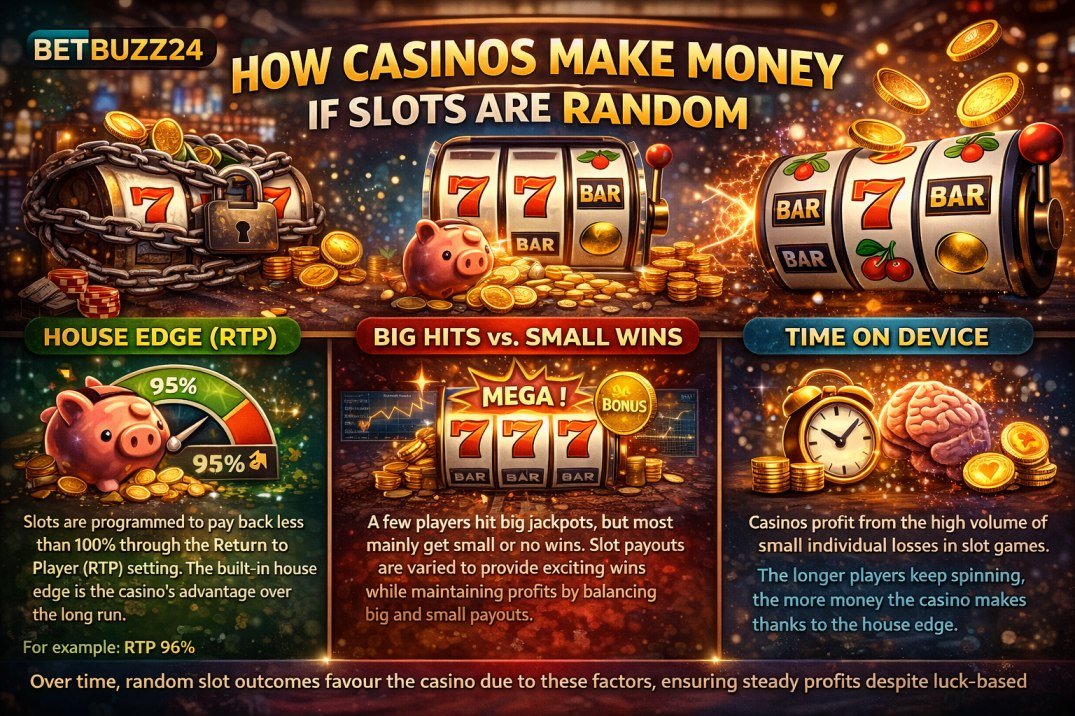
The house edge is the casino’s long-term profit margin on a game. It represents the percentage of all wagers the casino expects to keep over millions of spins.
For example, if a slot has a 5% house edge, the casino keeps about £5 for every £100 wagered over the long run. Players may win or lose in the short term, sometimes dramatically, but the overall system favors the operator.
This is why randomness does not mean equal chances. You can absolutely win, but the longer you play, the more the built-in edge tends to show.
RTP is the opposite side of the same coin. It shows the percentage of total wagers a slot is designed to pay back to players over time.
A slot with 96% RTP returns about £96 for every £100 wagered across all players, leaving roughly £4 as the casino’s edge. Importantly, this is an average across millions of spins, not a guarantee for any individual session.
You could deposit £20 and win £500, or deposit £200 and win nothing. RTP describes long-term behaviour, not short-term outcomes.
Volatility describes how a slot distributes its payouts.
Low-volatility slots pay small amounts frequently. Your balance moves slowly, and sessions tend to last longer.
High-volatility slots pay rarely but can deliver large wins. Long dry spells are normal, followed by sudden big payouts. This pattern often makes the game feel “cold” for long periods, then unexpectedly generous.
Understanding volatility explains why you might lose repeatedly on one game while another seems to pay often, even if their RTP is similar.
Together, house edge, RTP, and volatility explain how casinos earn money without needing to control individual spins. The system is built to be unpredictable in the short term but profitable in the long term.
While licensed slots are generally regulated and audited, not every gambling platform online follows those standards. In some situations, the problem isn’t the slot itself but the environment it’s offered in. This is where players are most likely to encounter genuinely unfair conditions.
If a casino has no credible licence, or one from a very weak regulator, there may be little oversight of its games, payouts, or business practices. These sites can operate with minimal accountability, making it harder for players to resolve disputes or verify fairness.
Some offshore casinos are legitimate, but others may delay withdrawals, impose unclear rules, or disappear entirely. Without strong regulation, you’re relying mostly on trust.
Not every slot you see online comes from an official game provider. Some shady platforms use copied or modified versions of popular games that look identical to the real thing but run on different software.
These clones may not follow certified payout rates or RNG standards. To a player, everything looks normal until withdrawals fail or gameplay feels unusually harsh.
Many mobile apps, social media games, or unofficial gambling platforms operate outside regulated ecosystems. Some run on private servers where outcomes can be adjusted or payouts restricted.
These apps often attract players with easy sign-ups, no verification, or unusually generous promotions. Because they aren’t part of regulated markets, there may be no meaningful consumer protection if something goes wrong.
Even at licensed casinos, bonuses can create situations that feel unfair. Large welcome offers often come with wagering requirements, betting restrictions, or withdrawal caps that make cashing out difficult.
For example, you might win while using a bonus but still be required to wager many times the bonus amount before withdrawing. If you don’t meet the conditions exactly, winnings can be reduced or voided according to the rules you agreed to.
In practice, fairness online depends as much on the platform and terms as on the slot itself. A certified game on a trustworthy site can offer a fair experience, while the same-looking game in the wrong environment can carry significant risk.
This is one of the most common fears among players, especially after a sudden losing streak or a big win that quickly disappears. It can feel like the game is reacting to your behaviour. In regulated environments, however, there are strict technical and legal limits on what casinos can actually do.
Yes, the casino can see your account balance, deposits, withdrawals, and gameplay history. That information is needed to manage your account and transactions.
What they cannot do at licensed casinos is adjust slot results based on your balance. Certified games run on independent RNG software supplied by game providers, not the casino itself. The operator hosts the game but does not control each outcome.
Licensed casinos cannot legally change a slot’s payout behaviour on the fly for a specific player or session. The game’s RTP and mechanics are fixed within approved parameters and monitored by regulators and testing labs.
What often creates this impression is player behaviour. After a win, people tend to keep playing longer, increase their bets, or try to repeat the success. Because the long-term edge favors the casino, losses after a win are common and can feel like the machine “turned against you.”
There is no credible evidence that regulated casinos secretly give new users better payouts to hook them. Certified slot software produces outcomes randomly, regardless of whether you are new or experienced.
New players may simply remember early wins more vividly or play cautiously at first, which can create the perception that results were better at the beginning. As play time increases, normal variance and the house edge become more noticeable.
In short, licensed casinos track your account activity but do not personalise slot outcomes. If something feels targeted, it is usually the combination of randomness, session length, and human psychology rather than direct manipulation.
One of the most confusing (and painful) experiences is hitting a strong win, feeling ahead for once, then watching it disappear faster than it came. It can feel like the game let you win just to take everything back. In reality, several normal factors often combine to create this pattern.
Many popular slots are high-volatility games. That means they don’t pay often, but when they do, the payouts can be large. Long quiet periods followed by a big hit are normal.
After a win, the game doesn’t “stay generous.” It simply returns to its usual pattern, which may involve many losing spins. If you keep playing the same session, you are likely to experience that dry period immediately after the high point.
This sounds technical, but the idea is simple. Extreme results tend to move back toward normal over time.
If you suddenly win far more than expected, continued play increases the chance that results will drift back toward the game’s average payout level. The system isn’t correcting you on purpose, it’s just randomness settling down after an unusually lucky moment.
What you do after a win often matters more than the win itself. Many players:
These decisions dramatically increase risk. A balance that felt like “casino money” can disappear quickly, especially on fast online slots.
Put together, a big win followed by losses is not usually evidence of manipulation. It’s the combination of volatile game design, natural statistical drift, and human behaviour in the excitement of the moment.
If you’ve played both, online slots can feel very different from machines in a physical casino. Faster spins, different payout patterns, and less visible mechanics often make people wonder which one is actually fairer.
Online slots use software-based Random Number Generators that can be tested, audited, and verified by independent labs. Because everything is digital, regulators and testers can analyse millions of spins to confirm the game behaves as advertised.
In land-based casinos, machines also use RNGs, but the process is hidden inside physical hardware. Players cannot see or verify anything directly, which can make outcomes feel more mysterious even when the machines are regulated.
Physical casinos operate under local gaming authorities and strict venue rules. Online casinos depend on the licence they hold, which can vary widely in strength.
Well-regulated online casinos must meet detailed standards for fairness, reporting, and player protection. Poorly regulated sites may have far fewer requirements. This is why online experiences differ so much from one platform to another.
Many online slots advertise higher Return to Player percentages than their land-based counterparts. Physical casinos have overhead costs such as buildings, staff, and maintenance, which can influence machine settings.
Online operators run digitally and can offer games with slightly better theoretical payouts. However, higher RTP does not guarantee short-term wins, it only describes long-term averages across huge numbers of spins.
In practice, neither format is automatically “fairer” in every situation. A regulated online casino with certified games can be just as fair as a licensed physical venue, while unregulated platforms carry far more uncertainty regardless of how attractive the games look.
Before worrying about strategies or luck, the most important step is making sure the game itself is trustworthy. A fair slot on a reputable platform gives you a real chance. The same-looking game on the wrong site may not.
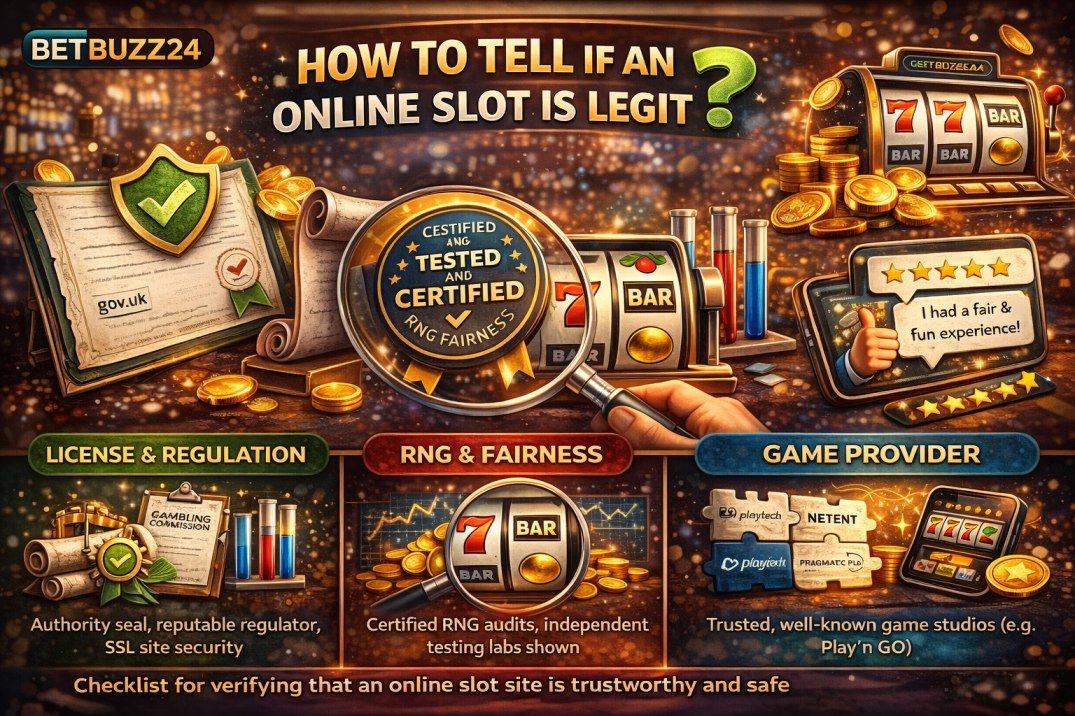
Start with the casino, not the slot. Legitimate operators display their licence information at the bottom of the website, including the regulator’s name and licence number.
Look for well-known authorities such as the UK Gambling Commission or Malta Gaming Authority. If you can’t find clear licensing details, or the information looks vague, that’s a warning sign. No licence usually means no real oversight.
Reputable slots openly state their Return to Player percentage, either in the game’s help section or on the casino site. This number shows the theoretical payout over time.
If you can’t find RTP information anywhere, it doesn’t automatically mean the game is fake, but transparency is a strong trust signal. Legitimate providers generally publish these figures.
Trusted casinos use established software developers whose names appear on the game screen or information panel. Well-known providers build their reputation on fairness and licensing compliance.
If the slot shows no developer name, or you’ve never heard of the provider and can’t verify them online, proceed carefully. Fake or modified games often hide their origins.
Be especially cautious with standalone apps, links from social media, or platforms that bypass official app stores and verification processes. Some operate outside regulated ecosystems and may offer little protection if something goes wrong.
In general, if signing up feels unusually easy, payouts sound too generous, or the platform lacks clear company information, it’s safer to step back. A legitimate casino should be easy to verify, not a mystery to investigate.
Slots are surrounded by advice, “tricks,” and confident claims from other players. Most of these ideas come from personal experience, not how the games actually work.
After a long losing streak, it feels logical that a win must be coming. In everyday life, things tend to balance out. Slots don’t work that way.
Each spin is independent. The game has no memory of how long it has been since the last payout, so a machine that hasn’t paid for hours is not any closer to a win than it was at the start.
Some players tap or click to stop the reels manually, believing timing can influence the outcome. In modern online slots, the result is determined the instant you press spin.
The animation that follows is just a visual display of a result that already exists. Stopping the reels early does not change what symbols were chosen.
Increasing your stake can unlock higher payouts or bonus eligibility in some games, but it does not improve the underlying odds of winning on any single spin.
Higher bets simply mean higher risk and larger swings. You might win more, but you can also lose your balance much faster.
It’s common to hear that slots pay better late at night, on weekends, or when fewer people are playing. Online slots do not adjust based on time or player traffic.
Because outcomes are generated randomly by software, the game behaves the same whether you play at noon or 3 a.m.
Most slot myths exist because randomness feels uncomfortable. When money and emotions are involved, the brain searches for patterns, control, or hidden rules, even when none are there.
Slots are designed to keep you spinning, especially when you’re losing or emotionally invested. The hardest part isn’t understanding the risks, it’s recognising the moment when continuing will likely make things worse, not better. Stopping at the right time protects both your money and your peace of mind.
Leaving at these points isn’t weakness, it’s control.
Licensed online slots are random, but designed so the casino profits over time. Outcomes aren’t tailored to you, yet the house edge means longer play usually favours the operator.
Unlicensed or poorly regulated sites carry real risk, including unfair practices or unreliable payouts.
Most losses on legitimate platforms come from math and speed of play, not cheating. Wins are possible, but long-term profit for players is unlikely.
What you can control is where you play, how much you risk, and when you stop.
Yes, licensed online slots use independently tested Random Number Generators (RNGs), which produce unpredictable results on every spin. However, randomness does not remove the house edge, so outcomes still favour the casino over time.
No reliable strategy can overcome the built-in house edge in the long run. Players can win in the short term, sometimes significantly, but sustained profit is unlikely over many sessions.
No. Online slots do not change payouts based on time of day, player traffic, or day of the week. Each spin has the same odds regardless of when you play.
Demo play often feels easier because there is no real risk, so wins feel more noticeable and losses carry no pressure. In most licensed games, demo and real-money versions use the same mechanics, but your behaviour changes when real money is involved.
Crypto slots on licensed casinos can be fair if they use certified software and proper regulation. On unlicensed crypto platforms, transparency and player protection may be weaker, so risks are higher.