Physical Address
304 North Cardinal St.
Dorchester Center, MA 02124
Physical Address
304 North Cardinal St.
Dorchester Center, MA 02124


If you’ve ever opened two sportsbooks and seen 2.40, 7/5, and +140 for the exact same team, you’re not alone. Betting odds formats can look completely different, even though they represent the same probability.
That confusion is exactly why understanding how to convert betting odds matters.
Decimal odds are common in Europe and Canada. Fractional odds dominate UK horse racing. American odds, also called moneyline odds, are standard in the United States. If you don’t know how to switch between them, you can’t properly compare prices, calculate implied probability, or spot value.
Here’s the simple truth:
All betting odds represent probability.
They’re just displayed in different formats.
In this guide, you’ll learn:
And if you don’t want to do the maths manually, you can instantly convert odds, calculate payout, and check implied probability using our Betting Odds Calculator.
Let’s break it down in the clearest way possible.
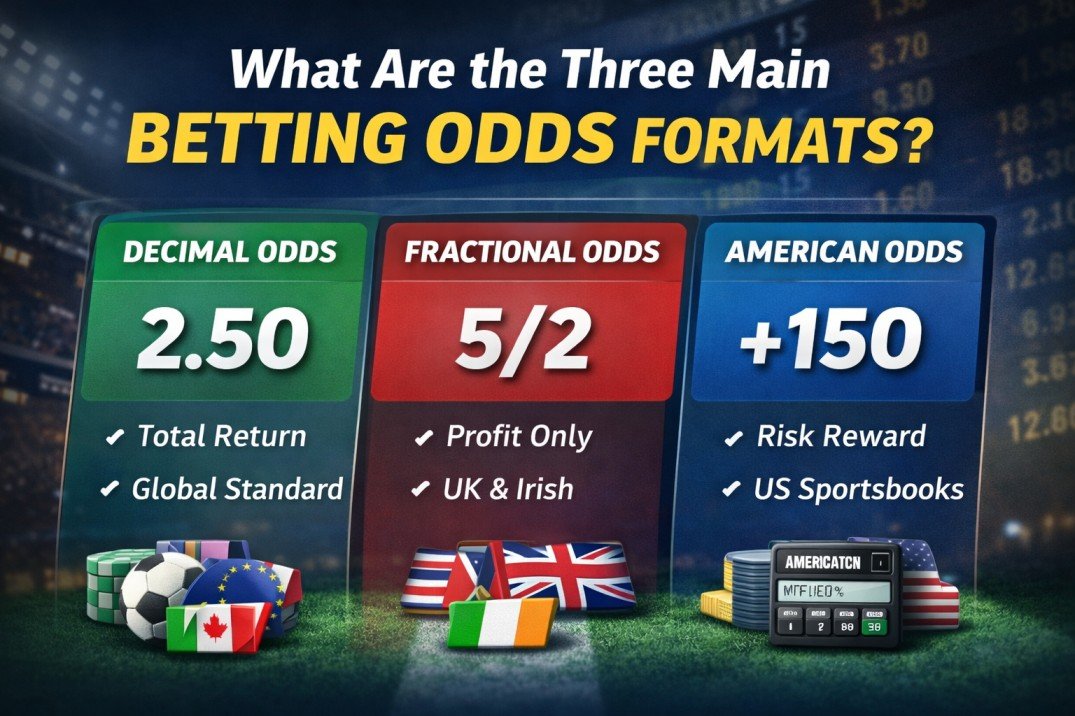
There are three main betting odds formats used worldwide:
They all represent the same thing, the probability of an outcome. The only difference is how that probability is displayed.
Let’s start with the simplest one.
Decimal odds are the easiest format to understand, especially for new bettors.
They show your total return, not just profit.
If you see:
2.50 odds
That means for every $1 you stake, you get $2.50 back if you win.
This includes:
Total Return = Stake × Decimal Odds
That’s it. One simple multiplication.
This is where beginners often get confused.
Decimal odds always show the total return amount, not just profit.
Let’s break it down step by step.
Stake: $20
Odds: 2.50
Total Return =
20 × 2.50 = $50
Now subtract your original stake:
$50 – $20 = $30 profit
So:
That’s how decimal odds work.
Decimal odds are popular in Europe, Australia and Canada because they’re clean, transparent and easy to compare across sportsbooks.
If you want to instantly convert decimal odds into fractional or American formats, calculate payout, or check implied probability at the same time, use our Betting Odds Calculator.
Fractional odds are most common in the UK and Ireland, especially in horse racing.
They look like this:
5/2
10/1
4/7
At first glance, they seem confusing. But they’re actually simple once you understand what the two numbers mean.
Using 5/2 as an example:
So 5/2 means:
You win $5 profit for every $2 you stake.
It does not include your original stake. Fractional odds show profit only.
Profit = Stake × (Numerator ÷ Denominator)
Then:
Total Return = Profit + Stake
We calculate the profit like this:
$20 × (5 ÷ 2)
The calculation above shows the profit result.
That gives you $50 profit.
Now add your original $20 stake:
Total return = $70
So:
Here’s something important:
5/2 fractional odds = 3.50 decimal odds
Why?
Because:
(5 ÷ 2) + 1 = 3.50
Decimal odds always include your stake in the number.
Fractional odds do not.
That’s why decimal odds are easier for beginners, they show total return directly.
If you want to instantly convert fractional odds like 5/2 into decimal or American formats without doing manual calculations, use our Betting Odds Calculator.
American odds, also called moneyline odds, are mainly used in the United States. They look different from decimal and fractional odds because they revolve around the number 100.
You’ll see them displayed like this:
+150
-150
The plus or minus sign is the key.
A +150 number represents an underdog.
It tells you how much profit you make on a $100 stake.
So:
If you stake $20 instead:
Profit = (20 × 150) ÷ 100 = $30
Total return = $50
Notice something?
+150 is the same as 2.50 decimal odds.
A -150 number represents the favourite.
It tells you how much you need to stake to win $100 profit.
So:
If you stake $20:
Profit = (20 × 100) ÷ 150 = $13.33
Total return = $33.33
Negative odds show stronger probability. The larger the minus number, the bigger the favourite.
Moneyline odds make it very easy to see who the favourite is instantly.
American odds became standard in US sportsbooks decades ago and are deeply tied to traditional betting culture. They’re especially common in baseball, basketball, and American football markets.
They also make risk and reward very clear in dollar terms, which many US bettors prefer.
What does +150 mean in betting?
+150 means you win $150 profit for every $100 you stake. It represents an underdog and equals 2.50 in decimal odds.
If you want to instantly convert +150 or -150 into decimal or fractional formats, calculate payout, or check implied probability in seconds, use our Betting Odds Calculator.
There are two scenarios.
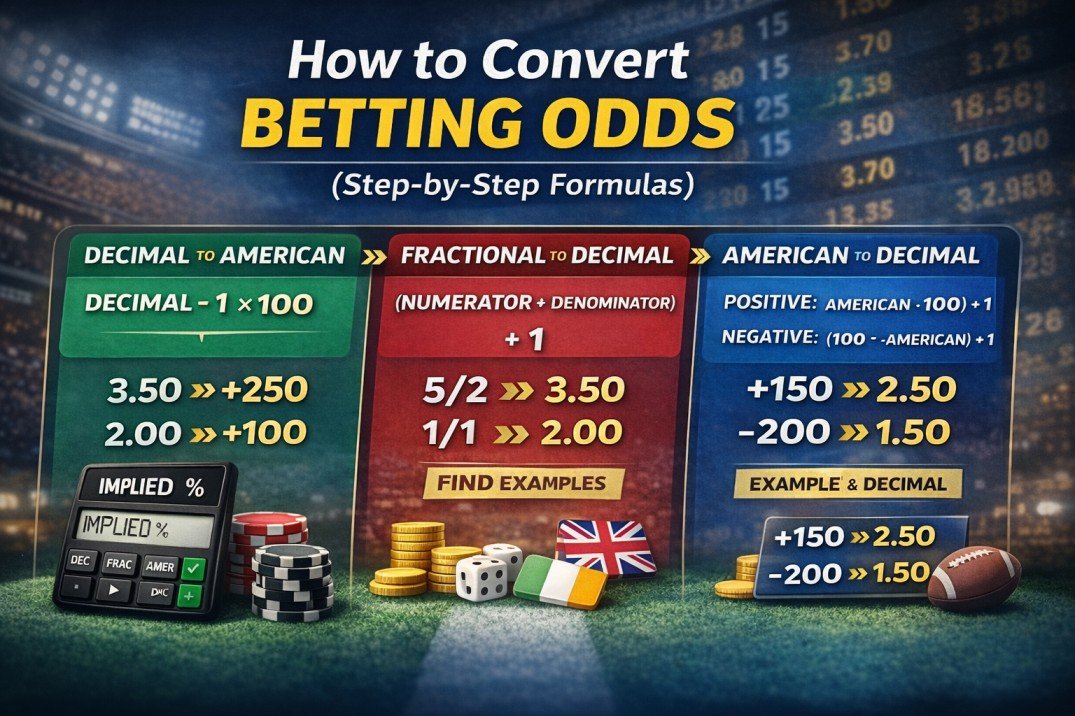
Formula:
(Decimal − 1) × 100
Example:
2.50 decimal
(2.50 − 1) × 100
= 1.50 × 100
= +150
So 2.50 = +150.
Formula:
-100 ÷ (Decimal − 1)
Example:
1.67 decimal
-100 ÷ (1.67 − 1)
= -100 ÷ 0.67
= -149.25 (usually rounded to -150)
So 1.67 ≈ -150.
Decimal 2.00 is the break point. Above it becomes positive American odds. Below it becomes negative.
Instead of doing the math manually every time, enter your odds into our Betting Odds Calculator:
Again, two scenarios.
Formula:
(American ÷ 100) + 1
Example:
+150
(150 ÷ 100) + 1
= 1.5 + 1
= 2.50 decimal
Formula:
(100 ÷ |American|) + 1
Example:
-150
(100 ÷ 150) + 1
= 0.6667 + 1
= 1.67 decimal
This conversion is critical when comparing US sportsbooks to European books.
Formula:
(Numerator ÷ Denominator) + 1
Example:
5/2
(5 ÷ 2) + 1
= 2.5 + 1
= 3.50 decimal
Another example:
4/5
(4 ÷ 5) + 1
= 0.8 + 1
= 1.80 decimal
Fractional odds convert cleanly into decimal. Decimal is the easiest format to compare across markets.
Step 1:
Decimal − 1
Step 2:
Convert result into a simplified fraction.
Example:
3.50 decimal
3.50 − 1 = 2.50
2.50 = 5/2
So 3.50 = 5/2.
Another example:
1.80 decimal
1.80 − 1 = 0.80
0.80 = 4/5
So 1.80 = 4/5.
Some decimals produce repeating fractions. In those cases, sportsbooks round to standard fractional formats.
Yes. Experienced bettors often use mental shortcuts.
Common shortcuts:
• +100 always equals 2.00 decimal
• +200 equals 3.00 decimal
• -200 equals 1.50 decimal
• Decimal 2.00 equals +100
• Decimal 1.50 equals -200
You can estimate favourites quickly:
If decimal is around 1.25, it’s roughly -400.
If decimal is around 1.10, it’s roughly -1000.
For underdogs:
Decimal 4.00 ≈ +300
Decimal 6.00 ≈ +500
But manual conversion fails when:
• You’re comparing multiple sportsbooks
• You need implied probability instantly
• You’re live betting
• You’re calculating payout at the same time
Small rounding errors can distort value decisions.
Every betting odds format represents an implied probability.
That number tells you the percentage chance the bookmaker is assigning to an outcome. It’s not the true probability, it’s the market’s priced probability.
Understanding this is where betting shifts from guessing to analysis.
Formula:
1 ÷ Decimal × 100
Using 2.50 decimal odds, the calculation above shows the implied probability result.
That means the bookmaker is pricing the outcome as having a 40% chance of winning.
Quick reference examples:
Decimal odds make implied probability extremely simple to calculate.
Two scenarios again.
Formula:
100 ÷ (Odds + 100) × 100
Example: +150
100 ÷ (150 + 100) × 100
= 100 ÷ 250 × 100
= 40%
Notice something important:
+150 equals 2.50 decimal
And both equal 40% implied probability.
Different format. Same probability.
Formula:
|Odds| ÷ (|Odds| + 100) × 100
Example: -150
150 ÷ (150 + 100) × 100
= 150 ÷ 250 × 100
= 60%
So -150 implies a 60% win probability.
The larger the negative number, the higher the implied probability.
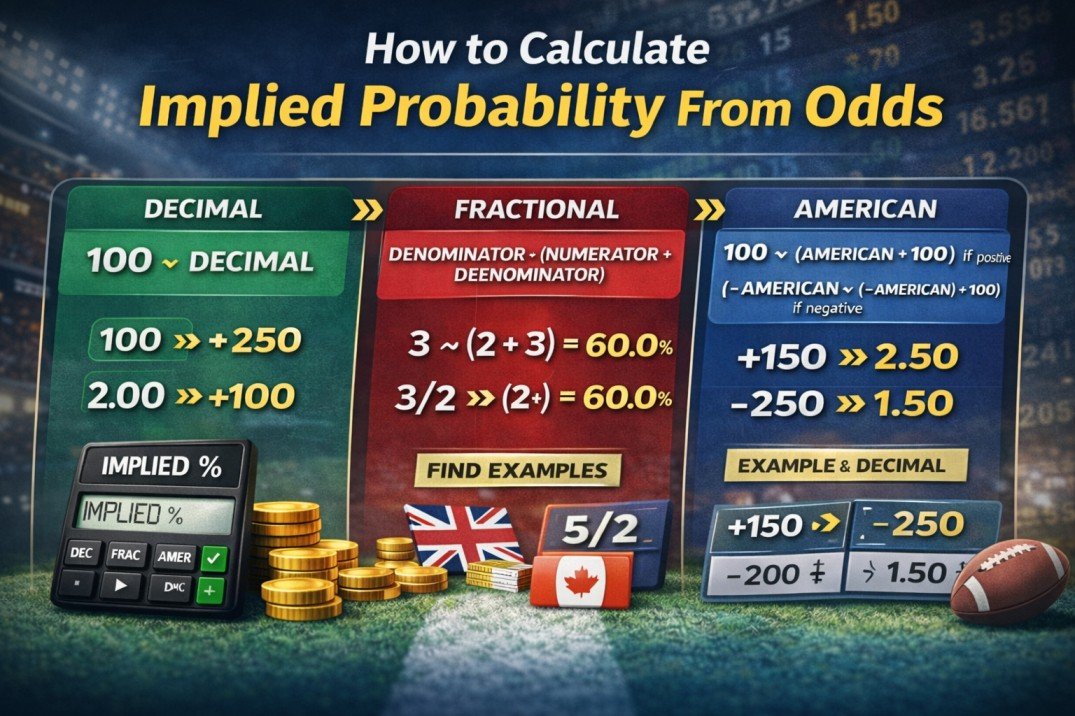
Formula:
Denominator ÷ (Numerator + Denominator) × 100
Example: 5/2
2 ÷ (5 + 2) × 100
= 2 ÷ 7 × 100
= 28.57%
Another example:
4/5
5 ÷ (4 + 5) × 100
= 5 ÷ 9 × 100
= 55.56%
Fractional odds are slightly less intuitive for probability, which is why many serious bettors convert them to decimal first.
If you add the implied probability of all outcomes in a market, it will usually exceed 100%.
Example in a two-way market:
Team A → 60%
Team B → 45%
Total = 105%
That extra 5% is the bookmaker’s margin, often called the overround.
This margin guarantees long-term profit for the sportsbook.
Understanding margin is critical if you want to identify value bets instead of just reading surface-level odds.
Sportsbooks do not price events at true probability.
They price them to make money.
That profit is built directly into the odds. It’s not visible at first glance, but it’s always there.
If you convert every outcome in a market into implied probability and add them together, the total will almost always exceed 100%. That excess percentage is the bookmaker’s edge.
Overround is the amount by which the total implied probability exceeds 100%.
In a perfectly fair two-outcome market, probabilities would add up to exactly 100%.
In real sportsbooks, they usually add up to somewhere between 102% and 108%.
That extra 2–8% is margin.
Team A → 1.67
Team B → 2.20
Convert both to implied probability:
Team A
1 ÷ 1.67 × 100 = 59.88%
Team B
1 ÷ 2.20 × 100 = 45.45%
Add them together:
59.88% + 45.45% = 105.33%
This market has a 5.33% overround.
That 5.33% is not random. It’s structural profit.
Lower overround means better prices for bettors. Higher overround means you’re paying more hidden margin.
If you compare the same match across three sportsbooks, you’ll rarely see identical prices. That’s not an error. It’s strategy.
Some sportsbooks operate on thinner margins to attract price-sensitive bettors. Others increase margin because their customer base focuses more on bonuses, convenience or brand trust.
A 103% market and a 107% market on the same event can produce noticeably different payouts.
Over time, those differences matter.
Not all sportsbooks cater to the same type of bettor.
Sharp books:
Recreational books:
When informed money hits the market, sharp books often move first. Others adjust later. That creates temporary price gaps.
Odds change because information changes and money moves.
Common triggers include:
Modern sportsbooks use real-time algorithms. If liability becomes too large on one side, prices shift to balance exposure.
Odds are not predictions. They are risk management tools.
Understanding margin changes how you read markets.
If you only look at the payout number, you miss the structure behind it.
If you understand implied probability and overround, you can compare books properly and spot better prices.If you want to see implied probability instantly across decimal, fractional and American formats without calculating manually, use our Betting Odds Calculator:
https://betbuzz24.com/betting-odds-calculator/
Betting odds are not static predictions. They are dynamic prices.
Sportsbooks constantly adjust them to reflect new information and manage risk. If you see a line move from +150 to +130 or from 2.10 to 1.95, that shift usually means something changed in the market.
Understanding why odds move helps you interpret the market instead of reacting emotionally to it.
Player availability has immediate impact.
If a starting quarterback is ruled out or a key striker is missing, the probability of that team winning drops. Sportsbooks adjust the odds to reflect the new reality.
Markets often move within seconds of confirmed news.
Not all bets are equal.
When professional bettors place large, respected wagers, sportsbooks pay attention. If sharp money consistently backs one side, odds will move even if public betting is balanced.
Sharp action can move a line before the broader market reacts.
Sportsbooks aim to manage risk, not predict outcomes perfectly.
If too much money is placed on one side of a market, the book may shift the odds to encourage betting on the opposite side. This reduces exposure.
Sometimes odds move not because the probability changed, but because the liability did.
Live markets operate differently from pre-game markets.
In-play betting is driven heavily by automated systems.
As the game progresses, algorithms update probabilities in real time based on score, time remaining, possession, pace and historical data patterns.
Human traders monitor, but most adjustments are model-driven.
Modern sportsbooks use predictive models that simulate outcomes thousands of times per minute.
If a basketball team goes on a scoring run or a football team enters the red zone, win probability updates instantly. The odds adjust accordingly.
This is why live betting lines can shift dramatically within seconds.
You can anticipate certain types of movement, but you cannot reliably predict all line changes.
You may spot likely shifts around:
But long-term line prediction is difficult because sportsbooks respond to both information and betting volume.
Serious bettors focus less on predicting movement and more on comparing prices and identifying value before the market fully adjusts.
Betting odds formats are not random. They developed from regional betting traditions.
If you’re comparing sportsbooks across the US, UK and Europe, you’ll often see the same event displayed in completely different formats. That’s not a pricing difference. It’s a formatting difference.
Understanding why each region prefers a certain format helps you move comfortably between markets and compare prices properly.
Decimal odds are standard across most of Europe, Australia and Canada.
They became dominant because they are mathematically clean and easy to understand:
For example:
2.40 means you receive 2.40 for every 1 staked.
That includes your stake.
Decimal odds are also simpler for online interfaces and algorithmic pricing, which is one reason they became the global digital standard.
For modern bettors comparing multiple sportsbooks, decimal odds are usually the most efficient format.
American sportsbooks historically used the moneyline format because it aligns with risk-based betting culture.
Moneyline odds focus on:
This format makes favourite vs underdog instantly clear.
In major US sports like NFL, NBA and MLB, moneyline pricing became deeply embedded in the market long before online betting expanded globally. As a result, the format remains standard across American sportsbooks.
For US bettors, moneyline feels intuitive. For international bettors, it often requires conversion before meaningful comparison.
Fractional odds are rooted in traditional British bookmaking, particularly horse racing.
Historically, bookmakers quoted prices as fractions because they expressed pure profit relative to stake. For example:
5/1 meant you win five units for every one unit staked.
Even though decimal odds are mathematically simpler, fractional pricing remains culturally embedded in UK racing and some traditional sportsbooks.
Online platforms in the UK usually allow switching between formats, but fractional persists due to long-standing betting habits.
If you’re betting across international sportsbooks, the format should never be the barrier.
The underlying probability is the same.
For example:
+150 (US)
2.50 (Decimal)
3/2 (Fractional)
All represent the same implied probability.
The difference is presentation, not pricing logic.
If you don’t convert, you can’t properly compare value across regions.
That’s why serious bettors standardise everything into one format, usually decimal, before making decisions.
Converting odds isn’t just about understanding formats.
It’s about understanding price.

Once you convert everything into implied probability, you stop asking, “Can this team win?” and start asking, “Is this price correct?”
That’s the difference between betting and investing.
A value bet exists when your estimated true probability of an outcome is higher than the bookmaker’s implied probability.
In simple terms:
If you believe something should happen more often than the odds suggest, you have value.
Example:
A team is priced at 2.50 decimal odds.
Implied probability = 40%.
If your research suggests the team actually wins 48% of the time, the market is undervaluing them.
That gap between 48% (your estimate) and 40% (bookmaker’s price) is value.
Over one bet, it means nothing.
Over hundreds of bets, it defines profitability.
This is why conversion matters. If you’re comparing +150 at one book and 2.60 at another, you must standardise the format before deciding which price is better.
Markets are not perfectly efficient.
There is a well-documented tendency for casual bettors to:
This behaviour is known as the favourite-longshot bias.
Long odds feel exciting. The potential payout attracts action. As a result, sportsbooks often shade longshots slightly lower than their true value.
That means longshots are frequently overpriced in emotional terms but underpriced in probability terms.
Understanding implied probability helps you see when odds are inflated by public behaviour rather than real probability.
Markets move on information and money, not emotion, but emotion influences where money flows.
Arbitrage exists when different sportsbooks offer prices that create a guaranteed profit across all outcomes.
This only becomes visible when you convert everything into the same format.
Example:
Sportsbook A:
Team A at +150
Sportsbook B:
Team B at 2.20 decimal
Convert +150 to decimal → 2.50
Now compare:
2.50 and 2.20
If the implied probabilities add up to less than 100%, an arbitrage opportunity exists.
Without conversion, that opportunity is invisible.
Arbitrage margins are usually small. A 1–2% gap disappears quickly. Accurate conversion is essential.
Odds conversion transforms betting from format confusion into price comparison.
Once you see everything as probability and margin instead of symbols and signs, you start reading the market correctly.
Converting odds is simple mathematically.
But small misunderstandings lead to expensive decisions.
Here are the mistakes that cost bettors the most over time.
This is the most common beginner error.
Decimal odds show total return, not profit. As explained clearly by Smarkets in their betting help guides, decimal pricing includes your original stake in the displayed number.
If you see 2.50 and stake $100:
Fractional odds show profit only.
American odds show profit relative to $100.
Mixing these up leads to incorrect comparisons across formats.
Always separate:
Profit = Return − Stake
Many bettors convert odds correctly but ignore the margin built into them.
As outlined in industry explainers from PinnMisreading Negative Moneyline
Negative American odds confuse many bettors.
-150 does not mean you win $150.
It means you must stake $150 to win $100.
Major US sportsbooks like DraftKings display moneyline pricing this way because it reflects risk relative to $100.
When converting:
-150 = 1.67 decimal
-200 = 1.50
-400 = 1.25
The larger the negative number, the stronger the favourite and the smaller the return relative to risk.
Misreading the minus sign creates payout miscalculations instantly.
acle, sportsbooks build margin into every market through overround.
Two sportsbooks may both show decimal odds around 1.90. But if one market has a 102% total implied probability and another has 107%, the long-term cost difference is significant.
Odds conversion tells you format.
Implied probability reveals pricing pressure.
If you’re not calculating total market percentage, you’re evaluating numbers without context.
Even after converting formats correctly, many bettors stop at the first price they see.
That’s a mistake.
Price differences between sportsbooks are common. Studies and data insights regularly published by BettingPros show how small line differences compound over time.
If one sportsbook offers 2.40 and another offers 2.50, that gap may look minor. But across hundreds of bets, it meaningfully impacts return on investment.
Odds conversion only becomes powerful when you compare across markets.
That’s where format flexibility matters.
If you want to convert instantly, calculate implied probability, and compare formats without manual error, use our Betting Odds Calculator:
+150 means you win $150 profit for every $100 you stake. It represents an underdog and equals 2.50 in decimal odds, which implies a 40% win probability.
If decimal odds are 2.00 or higher, subtract 1 and multiply by 100.
(4.0 − 1) × 100 = +300.
So 4.0 decimal equals +300 American odds.
For decimal odds, multiply your stake by the odds to get total return.
For example, $50 at 2.20 returns $110 total.
Profit is total return minus your original stake.
Higher odds mean higher potential payout, but lower implied probability. Bigger numbers don’t mean better value, they mean higher risk. Value depends on whether the price is higher than the true probability suggests.
Odds move when new information enters the market or when large amounts of money are placed on one side. Sportsbooks adjust prices to reflect probability updates and manage risk exposure.
Decimal odds are generally the easiest because they show total return directly and require only one multiplication to calculate payout. That’s why they’re the global standard across most online sportsbooks.