Physical Address
304 North Cardinal St.
Dorchester Center, MA 02124
Physical Address
304 North Cardinal St.
Dorchester Center, MA 02124


Betting winnings are calculated by multiplying your stake by the odds.
Formula:
Stake × Odds = Total Return
Stake × Odds − Stake = Profit
The total return includes your original stake plus your profit. The profit is the amount you win excluding your stake.
For example, if you bet $100 at decimal odds of 2.50:
Total Return = 100 × 2.50 = 250
Profit = 250 − 100 = 150
You would receive $250 back in total, and your actual profit would be $150.
Now, sportsbooks display odds in three main formats: decimal, American, and fractional. While the format changes, the core calculation logic remains the same. Understanding how betting winnings are calculated helps you compare odds, evaluate potential payouts, and avoid common mistakes beginners make.
If you prefer not to calculate manually, you can use our Betting Winnings Calculator to instantly determine your potential profit and total return for any odds format.
The betting payout formula is straightforward. No matter which sportsbook you use, the core math remains the same.
Total Return = Stake × Odds
The total return is the full amount you receive back if your bet wins. This includes both your original stake and your profit.
Example:
If you bet $80 at decimal odds of 3.00:
Total Return = 80 × 3.00 = 240
You would receive $240 back in total.
Profit = Stake × Odds − Stake
Profit is the amount you win after subtracting your original stake.
Using the same example:
Profit = 80 × 3.00 − 80
Profit = 240 − 80
Profit = 160
Your profit is $160. Your total return remains $240.
When using decimal odds, you can simplify the calculation:
Profit = Stake × (Odds − 1)
Example:
If you bet $50 at odds of 2.20:
Profit = 50 × (2.20 − 1)
Profit = 50 × 1.20
Profit = 60
This shortcut works because decimal odds already include your stake in the multiplier.
All betting odds represent a probability and a payout multiplier. Decimal odds show the total return directly. American and fractional odds express the same information differently, but they follow the same payout logic.
The difference is presentation, not mathematics.
Many bettors confuse profit with total return. Understanding the difference prevents payout misunderstandings.
Here are the definitions clearly:
If you bet $100 at odds of 2.50:
Total Return = 100 × 2.50 = 250
Profit = 250 − 100 = 150
Sportsbooks usually display the total return, not just the profit. A bettor may see “Potential Payout: $250” and assume they are winning $250 in profit.
In reality, only $150 is profit. The remaining $100 is the original stake.
This misunderstanding is one of the most common betting calculation mistakes.
If you want to know your actual winnings:
Always subtract your stake from the total return.
Understanding this difference makes it easier to compare odds, evaluate value bets, and avoid overestimating potential payouts.
Decimal odds are the simplest format to calculate. They are widely used in Europe, Canada, Australia, and on most global sportsbooks.
Decimal odds already include your stake in the number shown. That makes the calculation straightforward.
Total Return = Stake × Decimal Odds
Profit = Stake × (Decimal Odds − 1)
If you bet $100 at 2.00:
Total Return = 100 × 2.00 = 200
Profit = 200 − 100 = 100
At 2.00 odds, you double your money. Your profit equals your stake.
If you bet $50 at 3.50:
Total Return = 50 × 3.50 = 175
Profit = 175 − 50 = 125
You receive $175 back. Your actual profit is $125.
If you bet $200 at 1.75:
Total Return = 200 × 1.75 = 350
Profit = 350 − 200 = 150
Lower decimal odds mean lower profit relative to your stake.
That’s why decimal odds are considered the most beginner-friendly format.
If you want to quickly test different stake amounts or compare odds variations, using a betting winnings calculator can save time and prevent manual errors.

American odds are commonly used in the United States. They look different from decimal odds because they show either a positive number (for underdogs) or a negative number (for favorites).
The plus or minus sign determines how the payout is calculated.
Positive odds show how much profit you win on a $100 stake.
Formula (Profit):
Profit = (Stake × Odds) ÷ 100
Total Return:
Stake + Profit
Profit = (100 × 200) ÷ 100 = 200
Total Return = 100 + 200 = 300
You win $200 in profit and receive $300 back in total.
Profit = (50 × 150) ÷ 100 = 75
Total Return = 50 + 75 = 125
You win $75 in profit.
Negative odds show how much you must stake to win $100 in profit.
The calculation works differently.
Formula (Profit):
Profit = (Stake × 100) ÷ |Odds|
(|Odds| means the absolute value, without the minus sign.)
Total Return:
Stake + Profit
Profit = (150 × 100) ÷ 150 = 100
Total Return = 150 + 100 = 250
You must risk $150 to win $100.
Profit = (200 × 100) ÷ 200 = 100
Total Return = 200 + 100 = 300
You risk more money for smaller profit when betting favorites.
If you frequently bet using American odds, especially with varying stake sizes, using a betting winnings calculator reduces calculation errors and speeds up comparisons.
Fractional odds are traditionally used in the UK and Ireland. They are written as fractions such as 5/2, 7/4, or 10/1.
The fraction shows how much profit you win relative to your stake.
For example, 5/2 means you win $5 for every $2 you stake.
Profit = Stake × (Numerator ÷ Denominator)
Total Return = Stake + Profit
Profit = 100 × (5 ÷ 2)
Profit = 100 × 2.5
Profit = 250
Total Return = 100 + 250 = 350
You receive $350 back in total. Your actual profit is $250.
Profit = 40 × (7 ÷ 4)
Profit = 40 × 1.75
Profit = 70
Total Return = 40 + 70 = 110
You win $70 in profit.
To convert fractional odds to decimal:
Decimal Odds = (Numerator ÷ Denominator) + 1
Example:
5/2 → (5 ÷ 2) + 1 = 3.50
Once converted, you can use the decimal formula:
Total Return = Stake × Decimal Odds
This is often the easiest way to compare payouts across sportsbooks that use different odds formats.
Fractional odds may look different from decimal or American odds, but the underlying payout logic remains the same. They simply express profit as a ratio instead of a multiplier.
At first glance, decimal, American, and fractional odds may appear to produce different payouts. In reality, they represent the same probability and potential return, just displayed in different formats.
The difference is presentation, not mathematics.
For example:
All three represent the same implied probability and the same potential profit.
If you bet $100:
The payout is identical once calculated correctly.
It feels different because:
Each format emphasizes a different part of the payout structure.
Sometimes sportsbooks round odds slightly. For example:
Over larger stakes, this small difference slightly changes the total return.
That is not a formula difference; it is a pricing difference.
If you compare sportsbooks using different formats, you might think one offers better payouts. In reality, the odds may simply be displayed differently.
Converting everything into decimal format makes comparison easier and reduces confusion.
This is especially useful when testing different stakes or evaluating multiple betting markets.
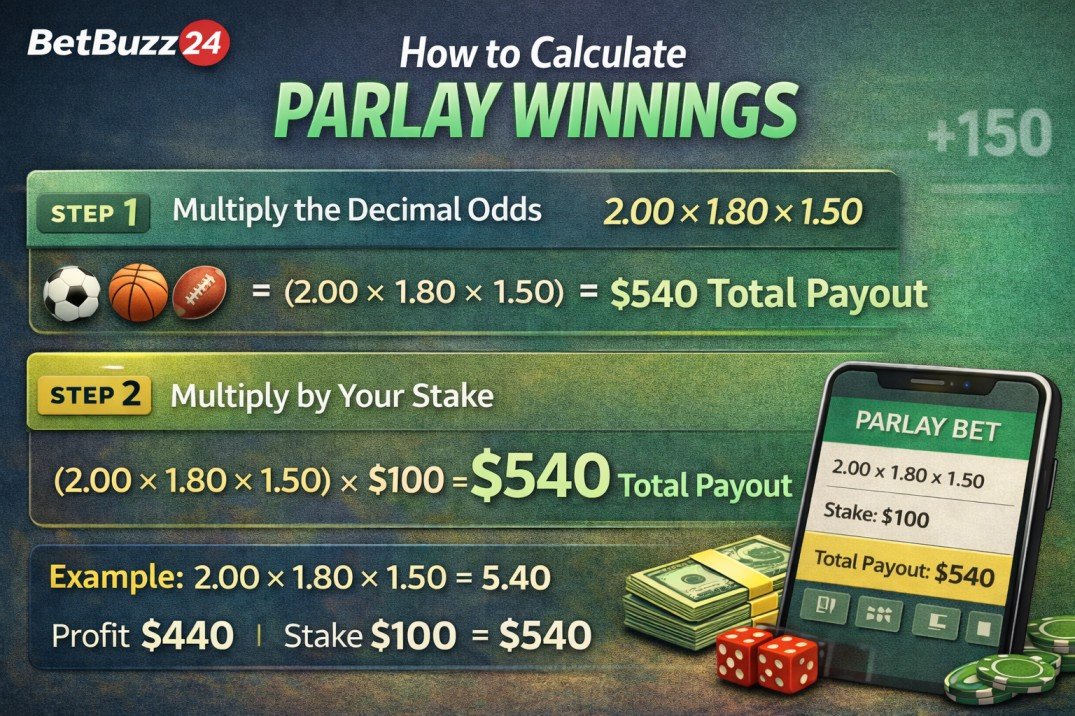
A parlay, also called an accumulator, combines multiple bets into one. All selections must win for the bet to pay out.
Parlay winnings are calculated by multiplying the odds of each selection together, then multiplying the result by your stake.
Step 1: Multiply all decimal odds together
Step 2: Multiply the combined odds by your stake
Total Return = Stake × (Odds 1 × Odds 2 × Odds 3…)
Selection 1: 2.00
Selection 2: 1.80
Stake: $100
Step 1: 2.00 × 1.80 = 3.60
Step 2: 100 × 3.60 = 360
Total Return = 360
Profit = 360 − 100 = 260
You would win $260 in profit if both selections win.
Selection 1: 1.90
Selection 2: 2.10
Selection 3: 1.50
Stake: $50
Step 1: 1.90 × 2.10 × 1.50 = 5.985
Step 2: 50 × 5.985 = 299.25
Total Return = 299.25
Profit = 299.25 − 50 = 249.25
Parlays increase potential profit because the odds compound.
If using American odds:
Converting first avoids calculation mistakes.
Even small mistakes in manual calculation can lead to incorrect payout expectations.
For multi-leg bets, many bettors prefer using a betting winnings calculator to instantly compute total return and profit.
Even simple betting formulas can lead to errors. Most payout misunderstandings come from small calculation mistakes.
Here are the most common ones.
Many bettors see a “potential payout” number and assume that is pure profit.
Remember:
Total Return = Stake + Profit
If your payout shows $300 and you staked $100, your profit is $200, not $300.
When using the formula:
Stake × Odds
That gives you the total return, not the profit.
You must subtract your original stake to calculate actual winnings.
Positive American odds (+200) and negative odds (-200) use different formulas.
Using the wrong formula leads to incorrect profit estimates.
Some bettors compare fractional odds to decimal odds without converting them first.
All formats represent the same probability. Converting everything to decimal makes comparison easier and reduces confusion.
When multiplying several decimal odds together, rounding too early changes the final payout.
It is better to calculate with full precision before rounding the final result.
Odds reflect implied probability and payout potential.
Lower odds mean higher probability but lower profit.
Higher odds mean lower probability but higher profit.
Failing to understand this relationship often leads to unrealistic payout expectations.
Even experienced bettors prefer calculators when dealing with American odds or multi-leg parlays.
While the betting payout formula is simple, manual calculations are not always practical especially when comparing multiple bets or calculating parlay returns.
A betting winnings calculator becomes useful in several situations.
Parlays require multiplying several odds together. Even small rounding errors can change your final payout.
A calculator instantly shows:
This eliminates compounding mistakes.
Positive and negative American odds require different formulas. Switching between multiplication and division can lead to errors.
A calculator removes that complexity and shows the correct payout immediately.
You may want to test:
Instead of recalculating manually each time, a calculator adjusts instantly.
Different sportsbooks may display slightly different odds. Even a small change from 1.90 to 1.91 affects total return over larger stakes.
Using a betting winnings calculator helps you:
Manual math mistakes are common, especially under pressure during live betting.
A calculator reduces risk and ensures your payout expectations match reality.
If you want to calculate profit and total return instantly for decimal, American, or fractional odds, you can use the BetBuzz24 Betting Winnings Calculator to test different stake amounts and odds formats in seconds.
The formula to calculate betting winnings is:
Total Return = Stake × Odds
Profit = Stake × Odds − Stake
The total return includes your original stake. Profit is the amount you win after subtracting your stake.
To calculate profit from a bet, multiply your stake by the odds and then subtract your original stake.
For example, if you bet $100 at 2.50 odds:
Profit = (100 × 2.50) − 100 = 150
Your total return would be $250, but your actual profit is $150.
Return in betting means the total amount you receive back if your bet wins. It includes both your stake and your profit.
If you stake $50 and your total payout is $125, your profit is $75 and your return is $125.
American odds calculate payout differently depending on whether the number is positive or negative.
For positive odds (+200), you multiply your stake by the odds and divide by 100.
For negative odds (-150), you multiply your stake by 100 and divide by the absolute value of the odds.
After calculating profit, add your stake to get total return.
To calculate parlay winnings, multiply all decimal odds together first. Then multiply the combined odds by your stake.
If you combine 2.00 and 1.80 with a $100 stake:
2.00 × 1.80 = 3.60
100 × 3.60 = 360
Your total return is $360.
Your payout may look different because sportsbooks show total return, not profit. Small rounding differences in odds can also slightly change the final amount.
Always separate stake from profit when checking your payout.