
If you’ve ever played online slots, you’ve probably seen a percentage called RTP and wondered what it actually means and more importantly, whether it affects your chances of winning.
RTP (Return to Player) is one of the most important numbers in any slot game. It tells you how much of the money wagered on a game is expected to be paid back to players over time. For example, a slot with 96% RTP theoretically returns about $96 for every $100 wagered in the long run, while the remaining portion represents the casino’s edge.
However, RTP does not predict what will happen in a single session. You could win big in minutes or lose quickly despite a high RTP, because slots run on random outcomes rather than short-term averages.
Understanding how RTP really works, along with factors like volatility, hit frequency, and casino settings, helps you choose better games, manage your bankroll, and avoid common misconceptions about how slots pay out.
In this guide, you’ll learn what RTP in slots means, what counts as a good RTP, how it affects real gameplay, and how to check a slot’s payout percentage before you play.
RTP in Slots Explained
RTP (Return to Player) in slots is the percentage of all wagered money that a slot game is designed to pay back to players over the long term. It represents the theoretical return across thousands or millions of spins, not what an individual player will receive in a single session.
Real Example
If a slot has 96% RTP, it means that for every $100 wagered on the game overall:
- About $96 is paid back to players as winnings over time
- About $4 remains with the casino as the house edge
In real play, this return is uneven. One player might win a large amount quickly, while many others may lose, but across a very large number of spins, the average payout approaches the stated RTP. RTP represents the percentage of stakes returned to players over time, according to the UK Gambling Commission.
One-Sentence Takeaway
Higher RTP means better long-term value for players, but it does not guarantee short-term wins.
Why RTP Matters to Your Real Money
RTP isn’t just a number in the game info, it directly affects how fast your balance goes down and how long you can keep playing. Think of it as the slot’s built-in drain speed. Lower RTP means your money is expected to disappear faster over time.
Every slot has a house edge. A 96% RTP slot, for example, keeps about 4% of all wagers in the long run. That may sound small, but it adds up quickly, especially if you spin often. The more you play, the more that edge quietly turns into real losses.
RTP also impacts how long your bankroll lasts. Two slots with the same bet size can feel very different. Higher RTP usually means more playtime and more chances to hit features, while lower RTP games can burn through your balance much faster.
Most importantly, RTP is a long-term average, not a prediction for one session. You can still win big or lose quickly either way, but over many spins, results tend to move toward the listed percentage.
In simple terms, RTP won’t guarantee wins, but it strongly affects how long your money lasts and how costly the game is over time.
What Does 96% RTP Actually Mean in Real Play?
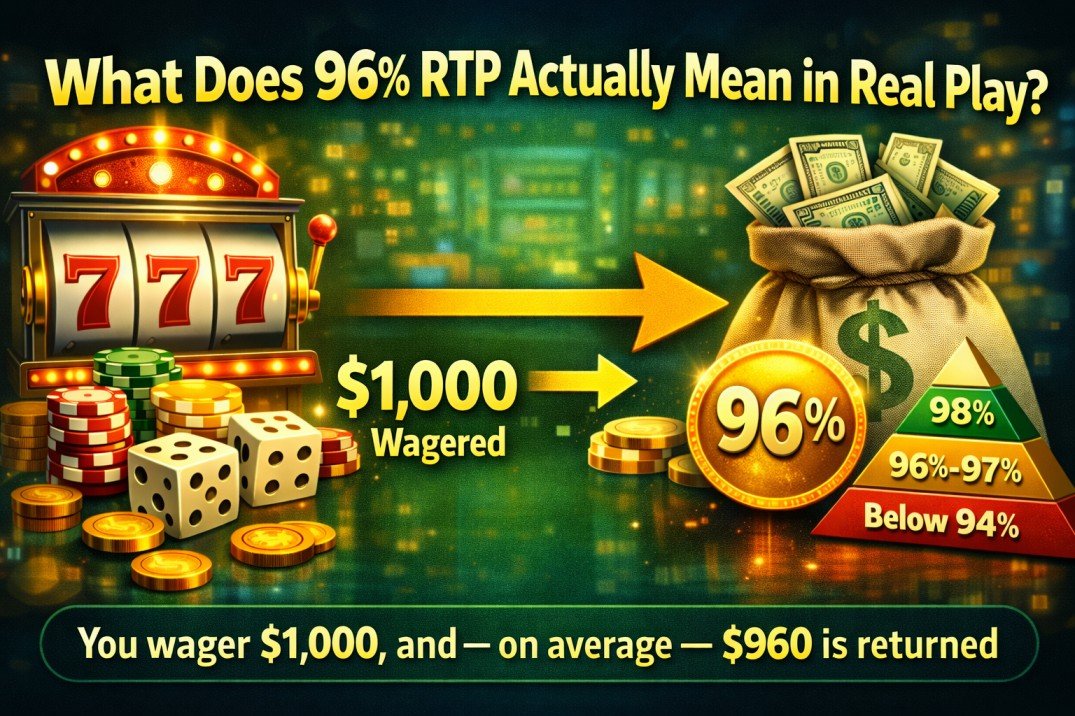
A 96% RTP slot is designed to return about $96 for every $100 wagered over a very large number of spins. In real play, outcomes vary a lot depending on how long you play, because results are driven by randomness in the short term.
In a short session, anything can happen. You might hit a bonus early and walk away with a profit, or lose quickly without seeing any significant wins. The RTP has almost no practical effect over just a few dozen spins.
Over a medium session, the casino’s edge starts to show more consistently. You may get several small wins or even a bonus round, but your balance will often trend downward unless you land a larger payout. This is where many players feel the game is “tight,” even though it’s behaving normally.
In a long session, results tend to move closer to the theoretical RTP. The ups and downs smooth out, and the average loss approaches roughly 4% of the total amount wagered. This doesn’t mean steady losses, it usually comes as cycles of wins followed by gradual decline.
In simple terms, 96% RTP does not describe what you will get back tonight. It describes the average return across thousands or millions of spins, which is why short sessions can feel lucky or brutal regardless of the percentage.
Is Higher RTP Always Better?
Not always. Higher RTP means better long-term value, but it doesn’t guarantee a better session.
Volatility matters just as much. A high-RTP slot can still have long losing streaks with rare big wins, while a slightly lower-RTP game may pay smaller amounts more often and feel steadier.
Bonus design also affects results. Some slots return most of their RTP through bonus rounds or jackpots, so the base game can feel tight if those features don’t trigger.
Your goal matters too. For long sessions, higher RTP helps your money last. For short play or chasing big wins, volatility and features often matter more than a small RTP difference.
In short, higher RTP is usually better on paper, but it’s not the only factor that determines how a slot actually feels to play.
RTP vs Volatility vs Hit Frequency
| Factor | What It Controls | Player Experience |
|---|---|---|
| RTP (Return to Player) | The long-term percentage of wagered money paid back to players. | Determines overall value and expected loss over time. Higher RTP generally means your money lasts longer. |
| Volatility (Variance) | How payouts are distributed — size of wins vs how often they occur. | High volatility = rare but big wins and long dry spells. Low volatility = frequent small wins and smoother play. |
| Hit Frequency | How often any winning combination appears. | High hit rate feels active with many small wins (not always profit). Low hit rate means longer losing streaks between wins. |
Can You Win More on High-RTP Slots?
In theory, yes – high-RTP slots give you better long-term value, meaning a smaller built-in loss over time. If two games are played equally, the higher-RTP one is statistically designed to return more money to players overall.
But this does not mean you will win more in a single session. Slots are random. You can hit a big win on a low-RTP game or lose quickly on a high-RTP one. Short-term results are driven by luck, not the percentage.
What high RTP really does is slow down the average loss and give your balance more staying power, which means more spins and more chances to hit bonuses or large payouts.
In simple terms, high RTP improves your odds over the long run, but it never guarantees profit, and it doesn’t protect you from bad streaks in the short term.
Do Casinos Manipulate RTP?
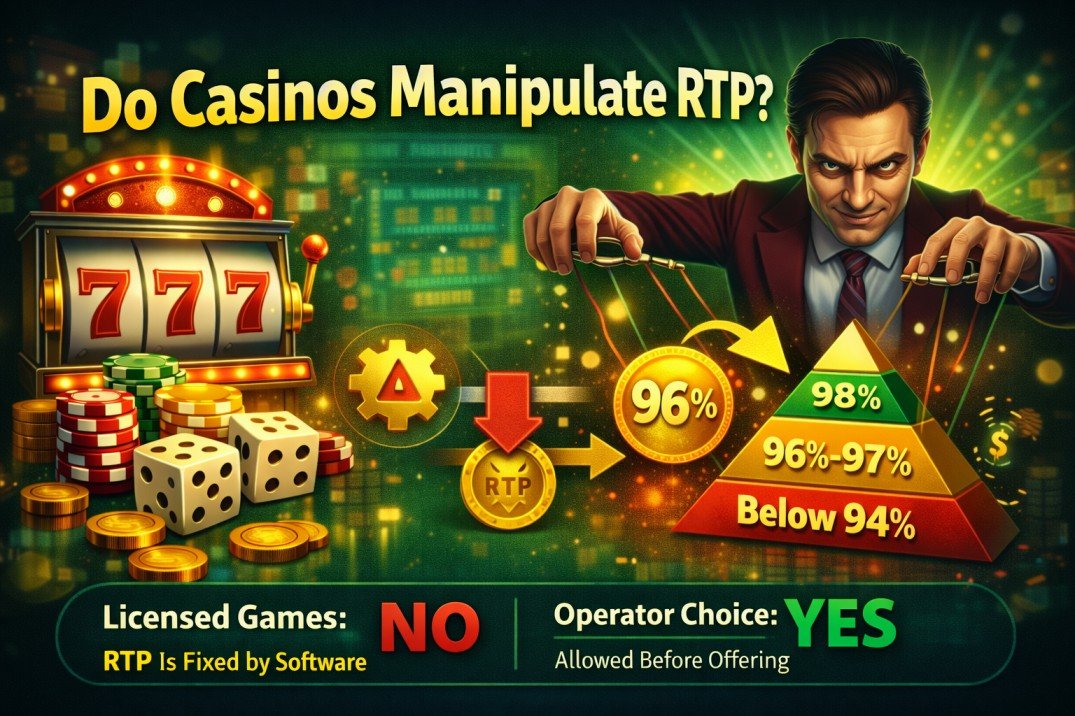
On licensed online casinos, RTP cannot be secretly changed during play. The percentage is built into the game by the provider, independently tested, and regulated. If a casino tampers with it, they risk losing their license.
However, casinos can choose between different approved RTP versions of the same slot (for example, 96% or 94%). Once selected, that version stays fixed for players.
The real risk comes from unlicensed or shady sites, where games may be unverified and the stated RTP may not reflect reality.
In simple terms, regulated casinos don’t manipulate RTP on the fly, but they can offer lower-RTP versions, and unregulated platforms may not follow any rules at all.
How RTP Is Calculated (Behind the Scenes)
RTP is calculated using simulations of an enormous number of spins, often millions or even billions, to estimate how much a slot will pay back over time. This creates a theoretical average that smooths out short-term randomness.
Every spin is determined by an RNG (Random Number Generator), a certified algorithm that produces unpredictable results continuously. It doesn’t track past spins, adjust to wins or losses, or try to “balance” outcomes, each spin is independent.
During testing, the game is run through massive simulated play sessions. The total amount paid out is compared to the total amount wagered, producing the RTP percentage. For example, if $96 million is returned from $100 million wagered, the RTP is 96%.
In real gameplay, you experience only a tiny fraction of those spins, which is why results can feel very different from the published percentage in the short term.
How to Check RTP Before Playing
Most online slots publish their RTP, but it’s often hidden in menus many players ignore. It only takes a few seconds to check if you know where to look.
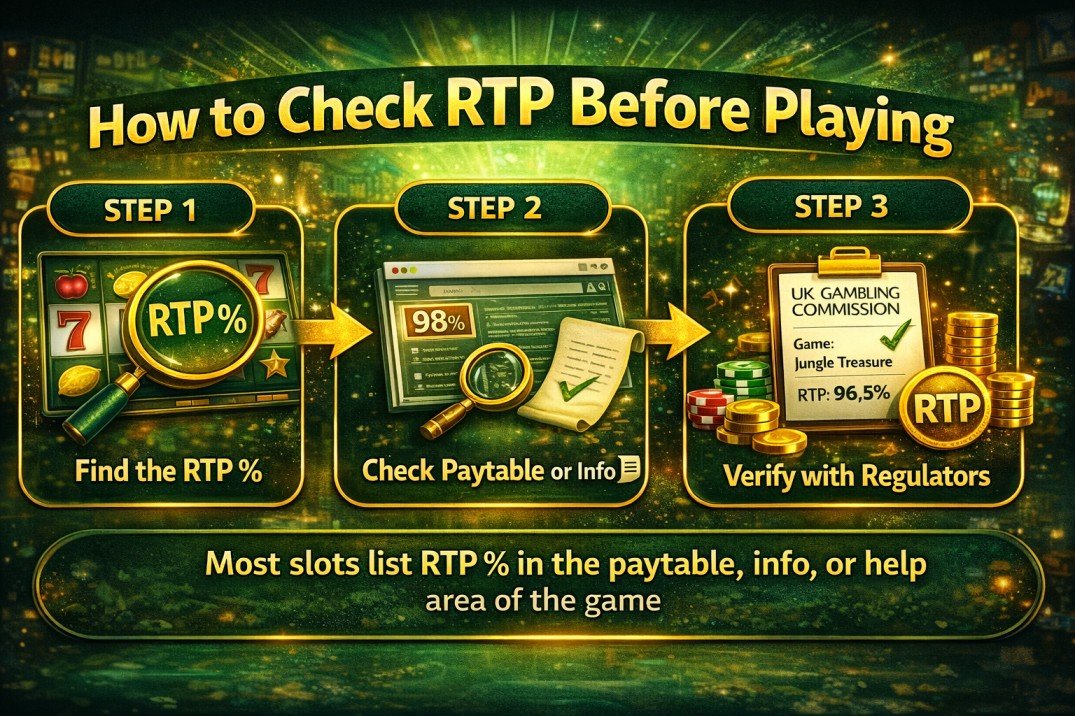
- Game info panel: Open the slot and tap the menu, info (i), or settings icon. Licensed games usually display the RTP here.
- Paytable or rules page: Scroll through the payout tables or game rules, the percentage is often listed near the bottom with other technical details.
- Provider website: Search the game name plus “RTP.” The developer’s official page often shows the default payout rate and available versions.
- Casino help or game details page: Reputable sites publish RTP data for transparency, especially for popular titles.
If you can’t find the RTP in any of these places, that’s a warning sign and a good reason to pick a different game or platform.
Highest RTP Slots in 2026
While most online slots fall in the 94%–97% range, a few well-known titles offer exceptionally high RTP, making them popular with value-focused players.
- Mega Joker (NetEnt) — Up to ~99% RTP in high-stakes mode
- Ugga Bugga (Playtech) — Around 99% RTP with optimal settings
- Ooh Aah Dracula (Barcrest) — About 99% RTP when played correctly
- Blood Suckers (NetEnt) — ~98% RTP, widely available
- 1429 Uncharted Seas (Thunderkick) — ~98.6% RTP
- Book of 99 (Relax Gaming) — ~99% RTP, one of the highest online
Availability varies by casino, and some games only reach their maximum RTP under specific conditions (such as max lines or special modes).
Does Bet Size Affect RTP?
In most modern online slots, changing your bet size does not change the RTP. The percentage is built into the game and applies proportionally to all stakes.
However, there are important exceptions that fuel confusion:
- Some older or land-based slots require maximum bets to qualify for jackpots or top prizes
- Certain games offer special modes (like gamble features or high-stakes versions) with different RTP
- Progressive jackpots often lower the base RTP because part of each bet funds the jackpot pool
For standard fixed-jackpot online slots, betting more simply increases both potential wins and potential losses, not the payout percentage itself.
In short, bet size usually affects volatility and risk, not the underlying RTP, but always check the game rules for exceptions.
Demo vs Real Money RTP
On licensed online casinos, demo and real money versions of a slot usually have the same RTP because they run on the same game software.
However, casinos can sometimes use different approved RTP versions for real play, while demos show the default setting. On unregulated sites, demo results may not reflect real gameplay at all.
In short, demo RTP is typically the same on reputable platforms, but it’s not a reliable predictor of real-money results.
Online Slots vs Land-Based RTP
Online slots usually have higher RTP than land-based machines. Online games often sit around 95%–97% or more, while physical casino slots are typically lower due to higher operating costs.
Online RTP is also more transparent, the percentage is usually shown in the game info, whereas land-based machines rarely display exact payout rates.
In short, online slots generally offer better theoretical value, while physical slots trade lower RTP for the in-person casino experience.
What Is a Good RTP for Slots?
A “good” RTP depends on what you want from the game, but in general, anything 96% or higher is considered strong for online slots. Since most games cluster between 94% and 97%, even a small percentage difference can noticeably affect how long your money lasts.
| RTP Range | Quality | What It Means for Players |
|---|---|---|
| Below 94% | Poor | Higher house edge, balance tends to drain quickly. |
| 94% – 95.9% | Average | Common range, acceptable for casual play. |
| 96% – 97.9% | Good | Strong value, money typically lasts longer. |
| 98%+ | Excellent | Very high return, rare but ideal for value-focused players. |
In simple terms, choosing slots with 96%+ RTP won’t guarantee wins, but it improves long-term value and usually gives your bankroll more staying power compared to lower-RTP games.
Quick Tips for Choosing Better Slots
- Aim for 96% RTP or higher whenever possible
- Check volatility if you care about win frequency vs big hits
- Verify RTP in the game info before playing
- Be cautious with progressive jackpot slots (often lower base RTP)
- Stick to licensed casinos to ensure the stated RTP is real
- Choose games that match your session goal, not just the highest percentage
Small differences in RTP won’t change one session, but they matter over time and can significantly affect how long your bankroll lasts.
FAQs
Is 96% RTP good?
96% RTP is considered good for online slots and is above the typical average, meaning the game is designed to return a relatively high portion of wagers to players over time.
Can RTP change?
RTP cannot change during gameplay on licensed casinos because it is built into the game software, but casinos may choose between different approved RTP versions before offering the game.
Do bonuses reduce RTP?
Bonuses do not change a slot’s built-in RTP, but wagering requirements and restrictions can lower your overall chances of withdrawing winnings.
What is the highest RTP slot?
The highest RTP slots can reach around 99% under optimal conditions, although most commonly available online slots fall in the mid-90% range.
Does RTP guarantee wins?
RTP does not guarantee wins because it represents a long-term statistical average, not what will happen in any single session.