

Hedge betting is placing a second bet against your original wager to reduce risk or guarantee profit. It is commonly used in live betting, parlays, and when odds shift significantly. By calculating the correct hedge amount, you can control your outcome instead of relying on one result.
Bettors usually hedge when:
- Odds shift significantly
- The final leg of a parlay is left
- A large profit is at stake
- They want to protect their bankroll
In this guide, you’ll learn the exact hedge formula, when to hedge, how to hedge a parlay, and whether hedging is better than cash-out.
If you want instant calculations, you can use our Betting Hedge Calculator to find the correct hedge amount in seconds.
What Does Hedge Betting Mean in Sports Betting?
Hedge betting means covering your original bet with an opposite wager to protect your bankroll or secure profit.
In practical terms, it’s a risk management strategy. Instead of letting one result decide everything, you place a second bet on the other side to balance the outcome.
Hedging works because:
- It reduces variance over time
- It lowers emotional pressure during high-stakes moments
- It trades maximum upside for greater certainty
The idea is simple. You place your original bet. If the odds shift or your position improves, you calculate how much to wager on the opposite outcome. Done correctly, this either locks in guaranteed profit or significantly reduces potential loss.
Quick Micro Example
- Original bet: $100 at 3.00 odds
- Potential payout: $300
- Opposing odds: 1.80
If you divide the $300 payout by 1.80, you get a hedge amount of $166.67.
Now:
- If your original bet wins, you still make a small profit.
- If the hedge wins, you also make a profit.
Instead of depending on one result, you’ve controlled the outcome mathematically.
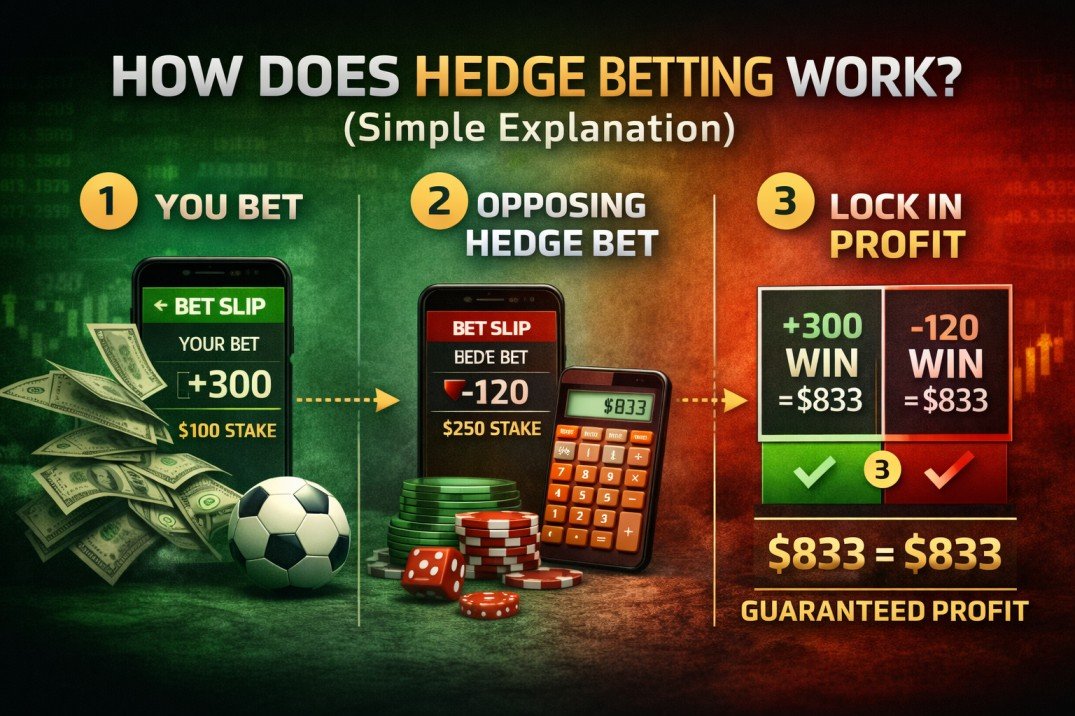
How Does Hedge Betting Work? (Simple Explanation)
Hedge betting follows a clear process.
- Place the original bet.
You back one team or outcome. - Odds change.
Your position improves, or the market shifts. - Place the opposite bet.
You bet on the other side. - Calculate the correct stake.
Use the total potential payout and divide by the opposing odds. - Lock the outcome.
One side wins, but you control the result either way.
The goal is not to maximise profit. The goal is to reduce risk and create certainty.
Short Example (Small Numbers)
- Original bet: $50 at 3.00 odds
- Potential payout: $150
- Opposing odds: 2.00
Hedge calculation:
150 ÷ 2.00 = $75
Now:
- If the original bet wins → You profit $25
- If the hedge wins → You also profit $25
Instead of guessing, you’ve balanced both sides. If you want to skip manual math, use our Betting Hedge Calculator. It calculates the exact hedge amount and shows both profit scenarios instantly.
Hedge Betting Formula (Exact Math Explained)
The basic hedge formula is:
Hedge Bet = Total Potential Payout ÷ Opposing Decimal Odds
This formula tells you how much to stake on the opposite side to balance your position.
Example Calculation
- Original bet: $100 at 3.00
- Total payout: $300
- Opposing odds: 1.80
Now apply the formula:
Hedge = 300 ÷ 1.80 = 166.67
So you would place $166.67 on the opposite outcome.
Outcome Comparison
If the original bet wins:
- You receive $300
- You lose $166.67 hedge
- Profit ≈ $33
If the hedge wins:
- You receive $300 (166.67 × 1.80)
- You lose $100 original stake
- Profit ≈ $66
The profits are not equal, but you have reduced risk and secured a positive outcome either way.
If you prefer not to calculate manually, you can determine the exact hedge amount instantly using our Betting Hedge Calculator.
How to Guarantee Equal Profit on Both Sides
To guarantee the same profit regardless of outcome, you must balance the hedge amount precisely.
The goal here is not just to reduce risk, but to make sure both outcomes return the same net profit.
Equal Profit Hedge Formula
To calculate a balanced hedge:
Hedge Bet = (Total Potential Payout − Original Stake) ÷ Opposing Decimal Odds
Or more precisely for equal profit:
Hedge Bet = Total Potential Payout ÷ (Opposing Odds + 1)
(This works when structuring both sides to net evenly.)
Let’s use a clear example.
Example
- Original bet: $100 at 3.00
- Total payout: $300
- Opposing odds: 2.00
To equalise profit:
Hedge = 300 ÷ (2.00 + 1)
Hedge = 300 ÷ 3
Hedge = $100
Now calculate outcomes.
Outcome Comparison
| Outcome | Profit |
|---|---|
| Original wins | $100 |
| Hedge wins | $100 |
Here’s how:
- If original wins → $300 return − $100 hedge − $100 original stake = $100 profit
- If hedge wins → $200 return − $100 original stake = $100 profit
Both sides produce the same result. This is how bettors lock in guaranteed, balanced profit when the odds allow it.
When Should You Hedge a Bet?
You should hedge a bet when the potential profit is large, the odds have shifted significantly, or protecting your bankroll is more important than maximising upside.
Hedging is about risk control. It makes sense when locking in profit is more valuable than chasing the full payout.
1. Final Leg of a Parlay
If only one leg remains and the payout is big, securing guaranteed profit can be smart.
2. Large Underdog Near Victory
You backed high odds, and now the favourite’s price has shortened. This creates a hedging opportunity.
3. Live Betting Volatility
In-play odds move fast. A major shift can allow you to balance both sides.
4. Bankroll Protection
If losing the bet would significantly impact your bankroll, reducing variance may be the better move.
The best time to hedge is when the math supports it, not when emotions take over.
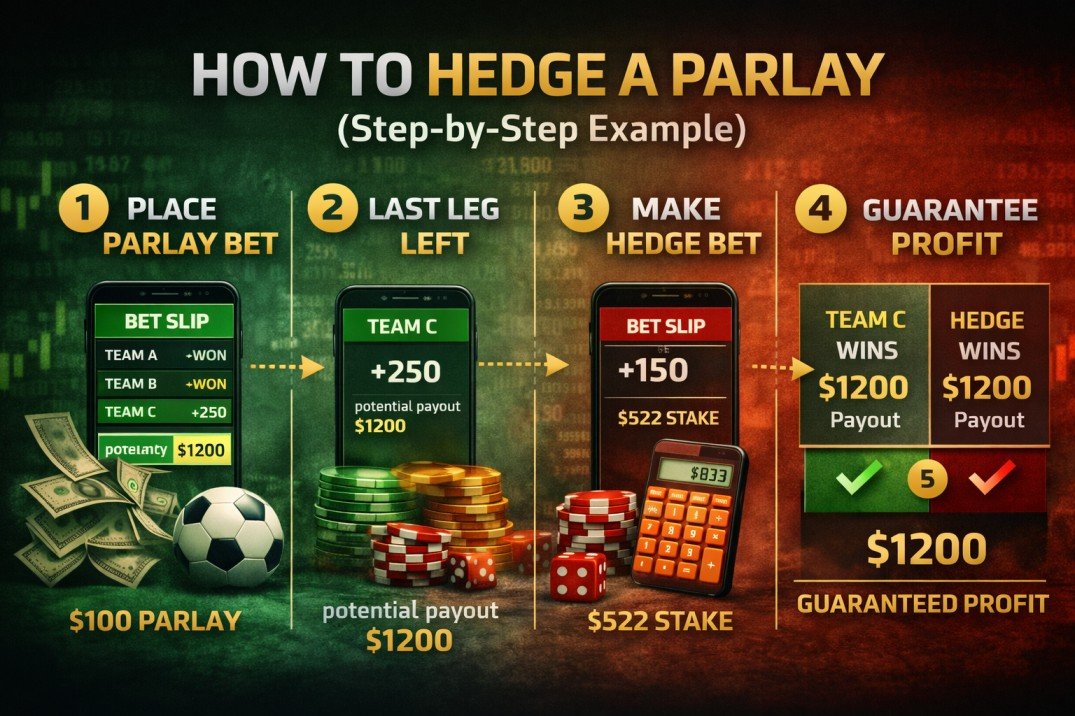
How to Hedge a Parlay (Step-by-Step Example)
To hedge a parlay, calculate the total payout of your ticket and divide it by the opposing odds of the final leg.
This is the most common hedge situation. You’ve already won several legs, and one game remains. Instead of risking the entire payout, you balance the final outcome.
Step 1: Check Your Total Payout
Example:
- $50 4-leg parlay
- First 3 legs won
- Total potential payout: $800
Only one game remains.
Step 2: Look at the Opposing Odds
The other side of the final game is priced at 2.00 decimal odds.
Step 3: Calculate the Hedge
Hedge formula:
Hedge Bet = Total Payout ÷ Opposing Odds
Hedge = 800 ÷ 2.00
Hedge = $400
Step 4: Compare Outcomes
If your original parlay wins:
- You receive $800
- Lose $400 hedge
- Profit = $350 ($800 − $400 − $50 stake)
If the hedge wins:
- You receive $800 ($400 × 2.00)
- Lose $50 original stake
- Profit = $350
You have now locked in equal profit on both sides.
This is the core idea behind a parlay hedge strategy. It allows you to secure guaranteed profit instead of risking everything on the last leg.
If you want to calculate your hedge instantly, use our parlay hedge calculator here.
It shows the exact hedge stake and both profit scenarios in seconds.
Hedge Betting vs Cash-Out – Which Is Better?
Manual hedging usually offers better value than sportsbook cash-out because it avoids built-in margin reductions.
Cash-out is built for convenience. Hedging is built for value. The difference shows up in the numbers.
Sportsbooks calculate cash-out offers below true market value to protect their edge. When you hedge manually, you choose the stake and can use better odds elsewhere.
Quick Comparison
Control
- Hedging: High
- Cash-Out: Low
Value
- Hedging: Often higher
- Cash-Out: Lower due to built-in margin
Speed
- Hedging: Slower, requires calculation
- Cash-Out: Instant, one click
This stacked format displays cleanly on mobile devices without horizontal scrolling.
Many bettors ask whether hedging is better than cashing out. In most cases, manual hedging provides stronger long-term value if calculated correctly.
Cash-out is faster, but it often reduces profit because the sportsbook adjusts the payout.
Arbitrage vs Hedging – What’s the Difference?
Hedging protects an existing bet, while arbitrage exploits pricing differences between sportsbooks to create guaranteed profit before the event ends.
Both strategies reduce risk, but they work in different ways.
Key Differences
Timing
- Hedging: Done after placing an initial bet, often when odds shift or a parlay reaches the final leg.
- Arbitrage: Executed immediately by placing bets on all outcomes at different sportsbooks.
Risk Profile
- Hedging: Reduces risk but may still depend on correct stake sizing.
- Arbitrage: Designed to eliminate risk entirely if calculated correctly.
Profit Structure
- Hedging: Balances outcomes to lock in profit or minimise loss.
- Arbitrage: Locks in small, guaranteed profit from price differences.
In short, hedging is reactive. Arbitrage is proactive.
Is Hedge Betting Profitable in the Long Term?
Hedge betting reduces variance, but it also reduces expected value if used too often.
It smooths the ride. It does not maximise growth.
Professionals treat hedging as a tool, not a habit. They hedge when the market shifts heavily, when exposure becomes too large, or when bankroll protection outweighs pure EV. The decision is mathematical.
Recreational bettors often hedge for comfort. A big payout feels close, and the fear of losing everything takes over. That emotional hedge may secure profit, but it can quietly reduce long-term returns.
Over-hedging is where profitability drops. If you consistently cap upside on strong value positions, your bankroll grows slower than it should.
In the long run, hedging works best when used selectively. It protects capital in high-volatility spots. Used too frequently, it becomes a safety net that limits growth.
When NOT to Hedge
You should not hedge if the original bet still has strong expected value and your bankroll can handle the variance.
Hedging lowers risk, but it also lowers upside. If your position is mathematically strong, locking in profit too early can reduce long-term returns.
Common mistakes:
Hedging Too Early
If the market has not moved significantly, you may be giving away value.
Hedging Small Edges
Small profit differences often do not justify cutting your long-term growth.
Emotional Fear Hedging
Large potential payouts create pressure. Hedging out of fear rather than logic quietly erodes expected value.
Long-term profitability depends on understanding expected value and variance. For a deeper mathematical breakdown, see Action Network’s guide on expected value in sports betting.
Hedging is powerful when used selectively. Used automatically, it limits growth more than it protects capital.
How to Calculate Your Hedge Instantly
The easiest way to calculate a hedge bet is by using an automated hedge calculator.
Manual formulas work, but small mistakes can change your profit outcome. A calculator removes guesswork and shows both scenarios clearly.
You only need three inputs:
Original stake
The amount you placed on your first bet.
Original odds
The decimal odds of your initial wager.
Opposing odds
The decimal odds for the opposite side you want to hedge.
Once entered, the calculator instantly shows:
- Exact hedge amount
- Profit if original bet wins
- Profit if hedge wins
Instead of running formulas yourself, you can use our free hedge betting tool here.
It calculates everything automatically and helps you decide whether locking in profit makes sense for your situation.
FAQs About Hedge Betting
What is hedge betting in simple terms?
Hedge betting is when you place a second bet on the opposite outcome to reduce risk or lock in profit. Instead of relying on one result, you balance both sides so you can control what happens to your money.
How do you calculate a hedge bet?
To calculate a hedge bet, take your total potential payout and divide it by the opposing decimal odds. The result tells you how much to stake on the other side to balance profit or minimise loss.
Can hedge betting guarantee profit?
Hedge betting can guarantee profit if the odds allow you to balance both outcomes correctly. When the math works and the stake is calculated precisely, you can secure a positive return either way.
Is hedging better than letting a bet ride?
Hedging is better if you want certainty and lower risk. Letting a bet ride is better if you want maximum upside and are comfortable with volatility. The right choice depends on your bankroll and long-term strategy.
Do professional bettors hedge?
Professional bettors hedge selectively. They do it when the numbers justify protecting profit or reducing exposure. They avoid emotional hedging and focus on expected value over time.