
Free Betting Odds Calculator (2026 Edition)
Free Betting Odds Calculator (2026), Convert Odds & See Payouts Instantly
This betting odds calculator gives you a quick, clear breakdown of any bet in seconds. Enter your odds and stake, and it instantly shows your payout, profit, break-even percentage, and implied probability. It supports American, Decimal, and Fractional odds and works smoothly on mobile, so you can check numbers on the go.
The tool is designed for everyday sports bettors who want simple answers without running formulas or opening spreadsheets. Whether you’re comparing prices, learning how odds work, or double-checking a potential bet, this calculator gives you fast, accurate results for 2026 betting markets.
How to Use the Betting Odds Calculator
Using this calculator is quick and straightforward. Just follow these steps.
- Enter your odds in American, Decimal, or Fractional format.
- Type the amount you plan to bet.
- The calculator instantly shows your total payout, profit, implied probability, and break-even percentage.
- Switch between odds formats if you want to compare different versions.
- Adjust your stake anytime to see how your potential return changes.
This section is meant to give users a fast, comfortable starting point without any extra details.
Quick Examples of Payouts and Conversions
Here are a few common scenarios to show how odds translate into payouts.
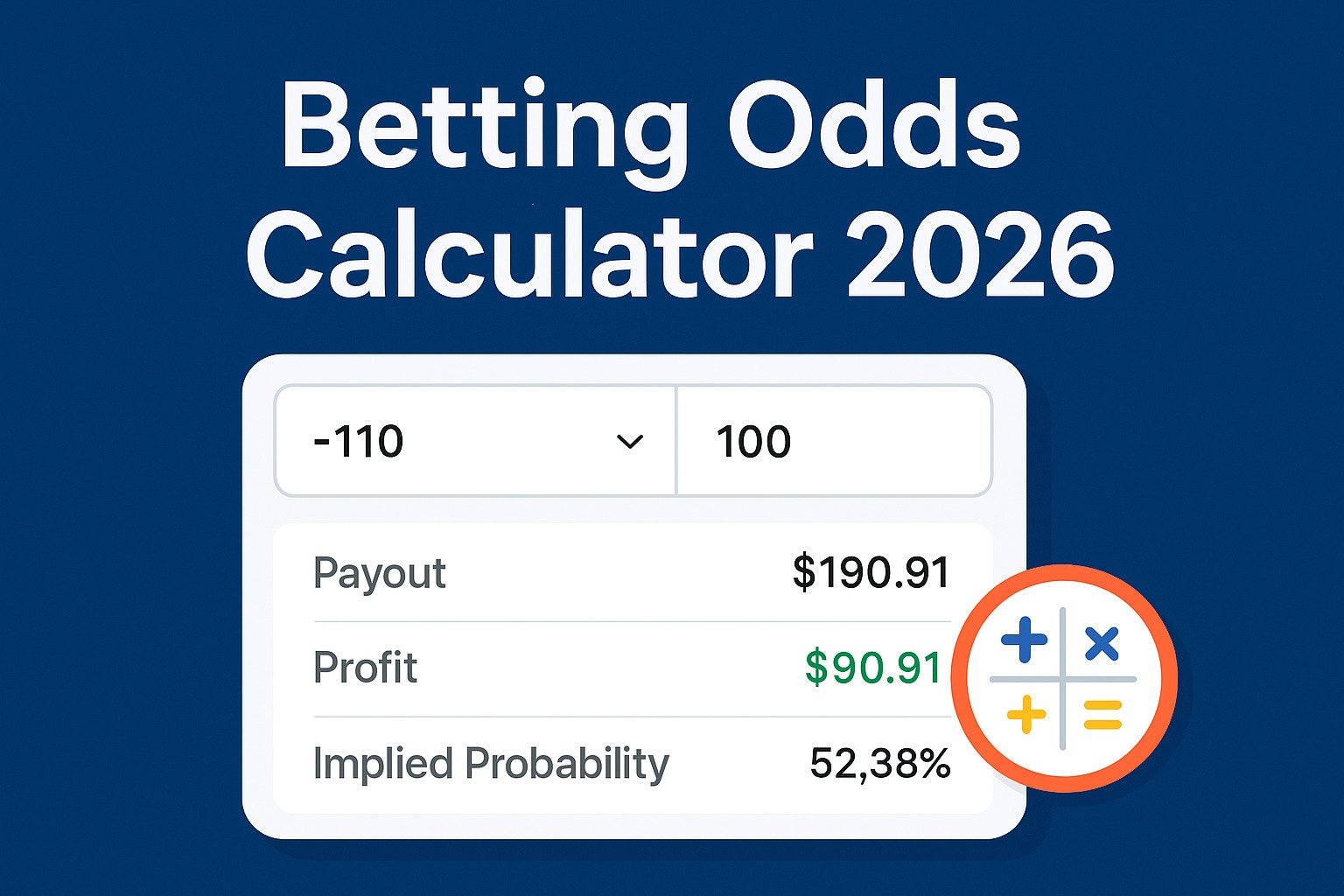
Example 1: American odds -110 with a 100 stake
Decimal odds are 1.91.
Your total payout would be 190.91 and your profit would be 90.91.
The implied probability is 52.38 percent.
Example 2: American odds +150 with a 50 stake
Decimal odds are 2.50.
Your total payout would be 125 and your profit would be 75.
The implied probability is 40 percent.
Example 3: Fractional odds 5/2 with a 20 stake
Decimal odds are 3.50.
Your total payout would be 70 and your profit would be 50.
The implied probability is 28.57 percent.
These examples help you see how odds formats connect directly to payout and risk.
Odds Formats Explained
Sportsbooks display odds in three main formats. Each format says the same thing but in a different style. Here is a quick guide to understand all three.
American odds
Positive odds show how much profit you make from a 100 stake.
For example, +150 means a 100 bet returns 150 profit.
Negative odds show how much you must stake to win 100 profit.
For example, -200 means you need to stake 200 to win 100.
Decimal odds
Common in Europe, Australia, and Canada.
Decimal odds show the total return for every 1 unit staked.
For example, 2.40 means every 1 returns 2.40 in total.
Profit is simply decimal minus 1.
Fractional odds
Popular in the UK and horse racing.
They show profit relative to stake, written as a fraction.
For example, 5/2 means you profit 2.5 units for every 1 staked.
You can convert fractional odds to decimal by adding 1 to the fraction result.
These formats look different, but once converted, they all lead to the same payout and implied win percentage.
Implied Probability Explained
Implied probability shows the chance of winning that is built into the odds. It helps you understand what the sportsbook is expecting before you place a bet.
Decimal odds
Implied probability is 1 divided by the decimal number.
For example, decimal 2.00 means a 50 percent implied chance.
American odds
Positive odds use the formula 100 divided by (odds plus 100).
Negative odds use the formula absolute value of odds divided by (absolute value plus 100).
Fractional odds
Implied probability is denominator divided by the sum of numerator and denominator.
Implied probability is useful because it lets you compare the sportsbook’s view with your own estimate. If your expected win chance is higher than the break-even percentage, the bet may offer value.
Payout and Profit Formula
Every bet has two numbers you care about: total payout and profit. The formulas are straightforward once you know the structure.
Normal bet
Payout is your stake multiplied by the decimal odds.
Profit is payout minus stake.
Free bet (stake not returned)
Profit is stake multiplied by decimal odds minus 1.
The stake itself is not part of the return.
Examples
If decimal odds are 1.91 and you stake 100, your payout is 191 and your profit is 91.
If decimal odds are 2.50 and you stake 50, your payout is 125 and your profit is 75.
If you use a free bet at decimal 3.00 with a 25 free stake, your return is 50 and you risk nothing.
These basic formulas cover almost every common betting scenario.
Betting Odds Calculator FAQ (2026)
Simple answers based on the questions people ask most when calculating odds, payouts, and probabilities.