Physical Address
304 North Cardinal St.
Dorchester Center, MA 02124
Physical Address
304 North Cardinal St.
Dorchester Center, MA 02124


A value bet in sports betting is a wager where the probability of an outcome happening is higher than the probability implied by the bookmaker’s odds. In simple terms, you believe the odds underestimate the true chance of the event.
Value betting is not about picking winners. It is about identifying when the price offered by the sportsbook is better than it should be.
For example, if a team is priced at 2.50 odds, the bookmaker implies a 40% chance of winning. If your analysis suggests the true probability is closer to 48%, that difference represents value.
Over time, consistently placing bets where your estimated probability is higher than the implied probability is what creates long-term profit potential. However, short-term results can still vary.
In this guide, we’ll break down implied probability, true probability, the value formula, and real sportsbook examples so you can understand how value betting actually works.
Implied probability is the percentage chance of an outcome based on the odds set by a sportsbook. It converts betting odds into a probability figure so you can see what chance the bookmaker is assigning to that result.
For decimal odds:
Implied Probability = 1 ÷ Decimal Odds
Example:
Odds of 2.50 → 1 ÷ 2.50 = 0.40 → 40% implied probability
Sportsbooks estimate the likely outcome of a match using data, models, and market information. They convert those estimates into odds and adjust them to include a margin. The displayed probability reflects both the estimated chance of the outcome and the bookmaker’s edge.
If you convert all outcomes in a market into probabilities and add them together, the total usually exceeds 100%. This happens because sportsbooks include a margin in the odds. That extra percentage ensures the bookmaker makes a profit over time.
Implied probability comes from the bookmaker’s odds. True probability is your own estimate of how likely an outcome actually is.
For example, odds of 2.50 imply a 40% chance of winning. That number is calculated directly from the price. Your true probability might be different if your analysis suggests the team has a stronger chance than the market reflects.
True probability is not taken from the sportsbook. It is built from research and judgment. Bettors estimate it using data, team performance, matchup analysis, injuries, situational factors, and sometimes statistical models. Two bettors can arrive at different true probabilities for the same event.
The difference between true probability and implied probability is where value exists. If the bookmaker implies a 40% chance but your analysis suggests 45%, that 5% gap is your edge. If your estimate is accurate over time, that edge is what produces long-term profit potential.
A value bet is measured using expected value (EV). Expected value calculates whether a bet is profitable based on your estimated probability.
EV = (True Probability × Decimal Odds − 1) × Stake
If the result is positive, the bet has value. If it is negative, it does not.
Your edge is the difference between your estimated probability and the bookmaker’s implied probability.
Example:
Edge = 45% − 40% = 5%
That difference is what creates value.
Odds: 2.50
True probability: 45%
Stake: $100
EV = (0.45 × 2.50 − 1) × 100
EV = (1.125 − 1) × 100
EV = 0.125 × 100
EV = $12.50
This means the expected return per $100 wagered is $12.50 over the long run. Expected value is a standard concept in probability theory used to measure average long-term outcomes. You can read more about the mathematical foundation of expected value.
Let’s walk through a realistic scenario using actual sportsbook pricing.
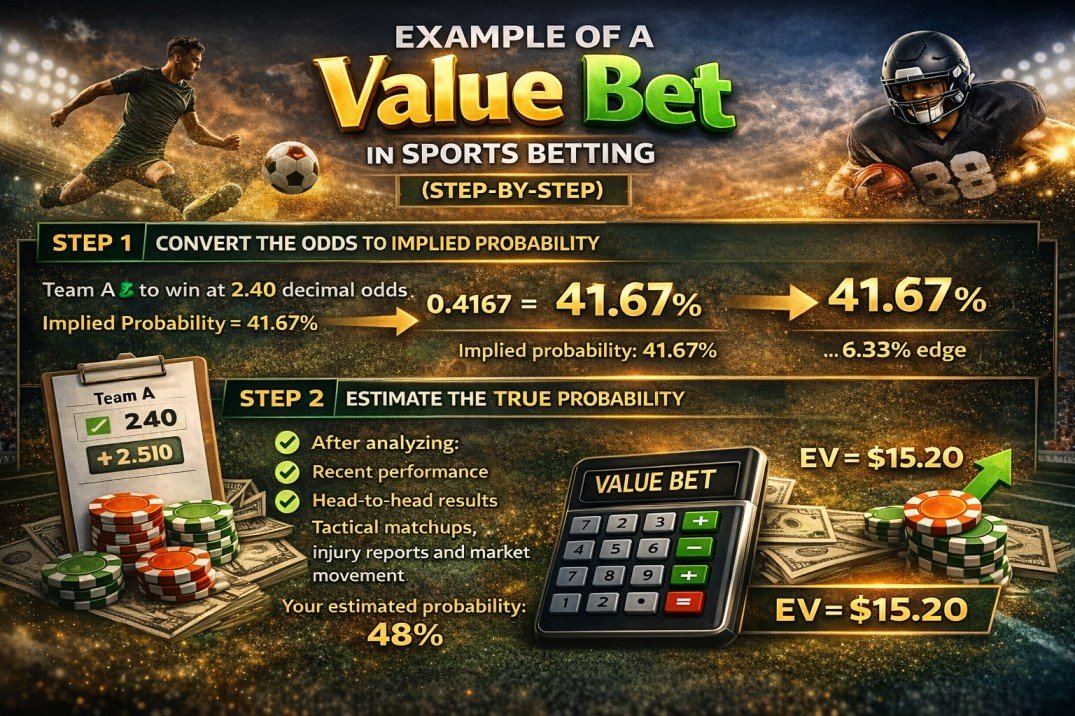
A sportsbook lists:
Team A to win at 2.40 decimal odds
Implied Probability = 1 ÷ 2.40
Implied Probability = 0.4167 → 41.67%
This means the bookmaker is pricing Team A as having about a 41.67% chance of winning.
After analysing:
You estimate Team A has a 48% chance of winning.
Your probability estimate is higher than the implied probability.
Implied probability: 41.67%
Your estimate: 48%
Difference: 6.33% edge
Stake: $100
True probability: 48%
Odds: 2.40
EV = (0.48 × 2.40 − 1) × 100
EV = (1.152 − 1) × 100
EV = 0.152 × 100
EV = $15.20
This means that over many similar bets, the average expected return is $15.20 per $100 wagered. You can test similar scenarios using a value bet calculator before placing your wager.
The sportsbook is pricing the event at 41.67%, but your analysis suggests 48%. That pricing gap creates positive expected value.
If your probability estimates are accurate over time, repeatedly betting at prices like this is how value betting generates profit.
If you want to calculate this instantly, you can use our Betting Value Calculator to see the expected value and edge percentage.
Value betting is based on probability, not certainty. Even if a bet has positive expected value, it can still lose.
If you estimate a team has a 55% chance of winning, that still means it loses 45% of the time. A positive edge increases long-term expectation, but it does not change the outcome of a single match.
Value betting only shows results over a large number of bets. Over 5 or 10 wagers, results can look random. Over 200 or 500 bets, the mathematical edge becomes more visible.
Short-term losing streaks are normal, even with positive EV bets.
Because short-term variance exists, discipline is required. Increasing stakes after losses or abandoning a method too early can erase the long-term advantage that value betting relies on.
Edge is the difference between your true probability estimate and the bookmaker’s implied probability.
A 2% edge can be profitable over a large sample.
A 5% edge is stronger and provides more cushion against variance.
Large edges are rare in efficient markets. Smaller edges are more common but require volume and consistency.
Most sustainable value betting strategies operate on small percentage advantages. Expecting double-digit edges regularly is unrealistic in major markets.
Sportsbooks build margin into their odds. That margin reduces available value and makes finding strong edges harder. Your edge must exceed the bookmaker’s built-in margin to produce long-term profit.
A value calculator helps determine whether a bet has positive expected value.

Input the decimal odds offered by the sportsbook.
Add your own true probability estimate based on analysis.
The calculator shows the difference between implied probability and your estimate. That difference is your edge.
The tool calculates expected value based on your inputs. A positive EV indicates theoretical value. A negative EV suggests the price is not favourable.
A value bet is a wager where your estimated probability of an outcome is higher than the probability implied by the bookmaker’s odds.
You calculate value by comparing your true probability estimate to the implied probability from the odds and using the expected value formula to determine profitability.
Positive expected value means the average return of a bet is greater than zero when calculated over many similar wagers.
Value betting can be profitable long term if probability estimates are accurate and applied consistently across a large sample of bets.
Value betting does not guarantee profit on individual bets. It is based on long-term probability and expected value, not single outcomes.