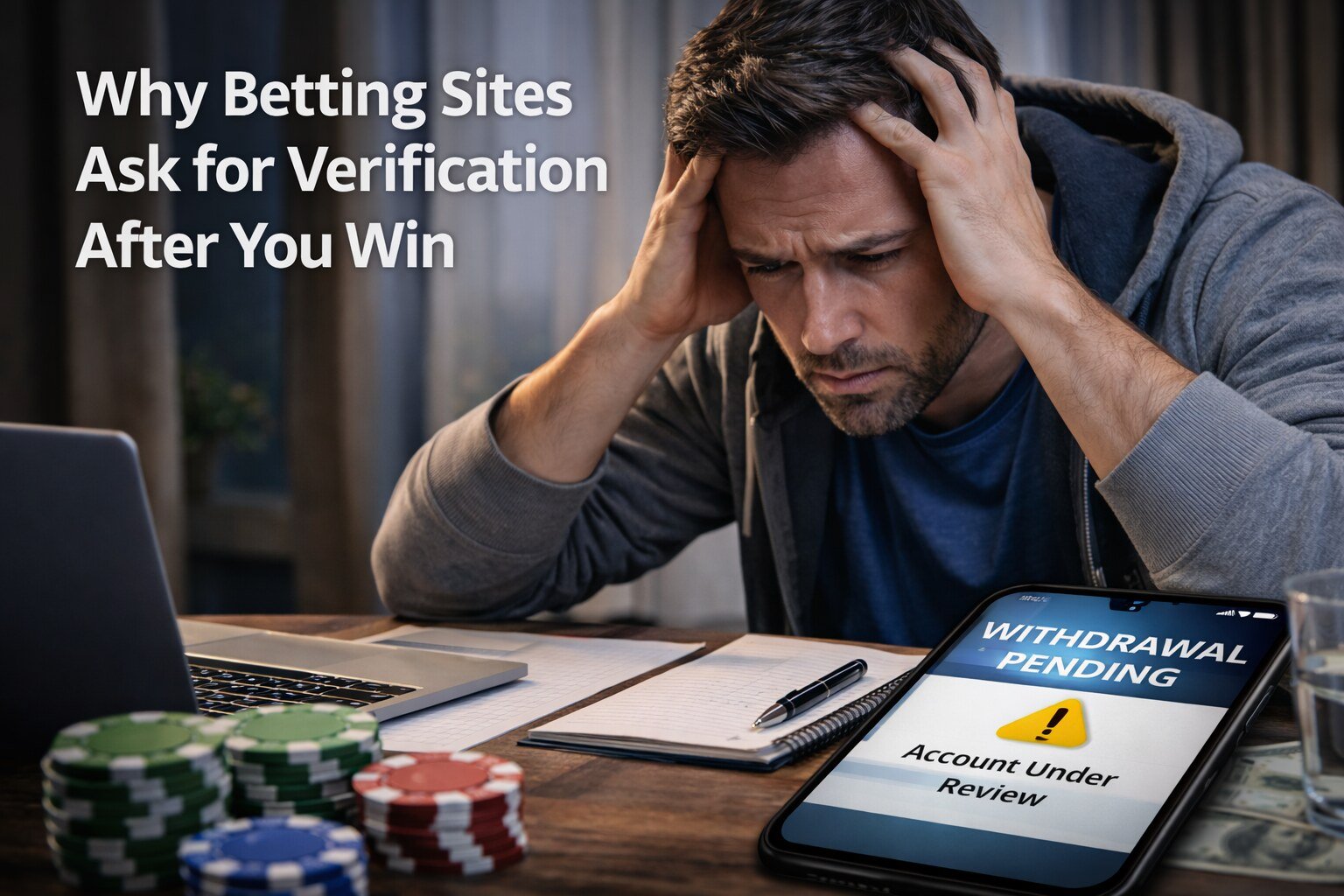
Betting sites ask for verification after you win because gambling laws require identity, age, and payment checks before any winnings are paid out. This process is known as Know Your Customer (KYC) and Anti-Money Laundering (AML) compliance, and it applies to all licensed bookmakers.
While it may feel suspicious when verification is requested only at the withdrawal stage, this is actually the legal checkpoint where betting operators must confirm who you are, that you are old enough to gamble, and that the money being withdrawn belongs to you. Regulators such as the UK Gambling Commission and state gaming authorities in the US require these checks to prevent fraud, underage gambling, and money laundering.
In this guide, you’ll learn why verification is triggered after winning, what documents bookmakers typically ask for, how long the process usually takes, and how to tell the difference between a legitimate compliance check and a potential red flag.
In 2026, most licensed betting sites complete full verification at withdrawal because that is the point regulators actually audit.
Placing bets or making deposits carries limited legal risk because those transactions can still be reversed. Once a withdrawal is requested, the bookmaker becomes legally accountable for paying the correct individual, to a valid payment method, using funds that meet anti-money-laundering rules. This is why regulators such as the UK Gambling Commission require identity, age, and payment checks before winnings are released.
Modern compliance systems are event-based, not constant. Large withdrawals, first-time cash-outs, unusual betting patterns, or changes in payment details automatically trigger verification. Losing accounts or small withdrawals often do not, which is why the process feels sudden after a win.
The timing is structural, not selective. Verification is not a response to winning, it is a response to money leaving the platform under regulatory responsibility.
Licensed bookmakers are not free to decide when or whom they verify. They operate under binding gambling regulations set by authorities such as the UK Gambling Commission, US state gaming regulators, and European licensing bodies.
These rules require operators to confirm three things before paying out winnings: who the customer is, whether they are legally allowed to gamble, and whether the money involved is legitimate. If a bookmaker fails to carry out these checks, the consequences fall on the operator, not the player. Penalties can include large fines, licence suspension, or permanent loss of the right to operate.
This is why verification is treated as a compliance obligation rather than a customer service choice. Even if a site wanted to skip checks to speed things up, it legally cannot do so on regulated markets. From a bookmaker’s perspective, releasing funds without proper verification is a far bigger risk than delaying a payout.
In short, verification exists to protect the licence first. Paying winners comes second.
In 2026, betting sites do not run full checks all the time. Most use risk-based compliance systems that activate only when something specific happens.
KYC (Know Your Customer) confirms you are a real person and legally allowed to gamble.
AML (Anti-Money Laundering) ensures gambling is not being used to move illegal money.
Source of Funds (SoF) checks are an extra layer used only in higher-risk situations.
What matters is not the terminology, but the trigger.
Typical triggers include:
Winning by itself is rarely enough. It is usually winning combined with one of these signals that activates additional checks.
Source of Funds requests cause the most concern, but they are not accusations. Bookmakers are required to show regulators, such as the UK Gambling Commission, that a customer’s gambling activity matches their financial profile and that funds are not coming from illegal sources. For most players, this check happens once, if it happens at all.
The important point is this: these checks are automated and event-driven. They are not personal decisions, and they are not designed to block legitimate withdrawals. They exist so the bookmaker can demonstrate compliance if audited.
When a bookmaker asks for verification, the documents requested are usually standard. They are meant to confirm identity, ownership, and legitimacy, not to invade privacy.
A government-issued photo ID such as a passport or driving licence. This confirms who you are and that you meet the legal gambling age.
A recent utility bill, bank statement, or official letter. This is used to confirm residency and regulatory location requirements.
Screenshots or partial statements showing that the card, bank account, or wallet used for withdrawals belongs to you. This helps prevent stolen card use and chargeback fraud.
Requested mainly for large withdrawals or unusual activity. This may include a bank statement or payslip showing where the money comes from. It is a regulatory requirement, not an accusation.
What matters is proportionality. One clear request is normal. Repeated requests without explanation, or demands beyond what is stated in the bookmaker’s terms, are not.
For most players, verification is a one-time process. Once completed, future withdrawals are usually quicker unless account details change.
Not every verification request is a problem. Most are routine. The key is knowing what looks normal and what should raise concern.
A legitimate betting site will:
On licensed platforms regulated by bodies like the UK Gambling Commission, this process is standard and expected.
Verification may be a problem if a bookmaker:
These patterns are not part of normal compliance and often point to poor internal controls or an untrustworthy operator.
Legitimate verification is specific, limited, and explainable.
Problematic verification is vague, repetitive, and open-ended.
Knowing the difference helps you stay patient when checks are normal and act quickly when something feels off.
Currently, verification is faster than it used to be, but it is not instant.
For most licensed betting sites, basic verification is completed within 24 to 72 hours once all required documents are submitted correctly. First-time withdrawals may take slightly longer because checks are being completed for the first time.
Delays usually occur for practical reasons, such as unclear documents, name mismatches, recent changes to payment methods, or larger withdrawal amounts that require additional review.
Most checks are automated, but anything involving source of funds or manual review can take several working days. Open-ended delays without explanation are not considered normal on properly regulated platforms.
As a general rule, if verification stretches beyond a week with no clear reason or communication, it is reasonable to follow up through official support channels.
If you choose not to complete account verification, most betting sites will simply pause withdrawals, not confiscate your winnings.
Your account usually remains open, but you won’t be able to withdraw funds until the required checks are completed. In some cases, betting activity may also be restricted to prevent further risk.
On licensed platforms, unverified funds are typically held safely rather than removed. However, if verification is ignored for a long period, the bookmaker may close the account and return deposits only, as outlined in its terms.
It’s also worth noting that refusing verification does not make the request go away. Regulatory rules require these checks before payout, so avoiding them only delays access to your winnings.
In practical terms, completing verification is not optional if you want to withdraw. It is a condition of using regulated betting services.
Verification after winning feels frustrating, but it is not a punishment and it is not a signal that a bookmaker is trying to avoid paying you. It is the point where gambling stops being casual entertainment and becomes a regulated financial transaction.
Most problems arise not because verification exists, but because players are not told early enough that it is unavoidable. On licensed betting sites, payouts cannot legally happen without identity and payment checks being completed.
The practical takeaway is simple. If you are betting on regulated platforms and your documents are genuine, verification is usually a one-time hurdle. Once it is done, future withdrawals tend to be smoother and faster.
Winning triggers attention, but regulation triggers verification. Knowing the difference saves time, stress, and unnecessary panic.
Betting sites verify accounts after you win because gambling regulations require full identity and payment checks before money is paid out. Verification is triggered at withdrawal, not betting, because that is when funds leave the platform under legal responsibility.
Yes, it is normal for bookmakers to ask for ID before withdrawal. Licensed betting sites must confirm identity, age, and account ownership before releasing winnings, even if you were allowed to bet earlier.
No, verification does not mean a betting site won’t pay your winnings. On regulated platforms, verification is a standard compliance step and payouts are usually processed once checks are completed successfully.
Betting site verification usually takes between 24 and 72 hours once correct documents are submitted. More complex checks, such as source of funds reviews, may take a few additional working days.
Betting sites usually ask for a photo ID, proof of address, and payment method confirmation. Source of funds documents are requested only in specific cases, such as large withdrawals or unusual activity.
A bookmaker generally cannot pay out winnings if you don’t verify, but funds are usually held rather than taken. If verification is never completed, the account may be closed according to the site’s terms.
No, verification is not a sign of cheating. Most checks are automated and triggered by withdrawals, account changes, or regulatory thresholds, not suspicion of wrongdoing.
If you want to win at sports betting long term, you need more than predictions.…
Parlays look exciting because they promise something simple and powerful: turn a small stake into…
If you’ve ever opened two sportsbooks and seen 2.40, 7/5, and +140 for the exact…
Hedge betting is placing a second bet against your original wager to reduce risk or…
A betting unit is a standardized way to measure your bet size using a percentage…
A value bet in sports betting is a wager where the probability of an outcome…
This website uses cookies.