If you want to win at sports betting long term, you need more than predictions. You need value.
Expected value, often shortened to EV, is the mathematical foundation behind profitable betting. It tells you whether a wager is likely to make or lose money over time based on probability and odds.
Most casual bettors focus on who will win. Professional bettors focus on whether the price is wrong.
That difference is everything.
In this guide, you’ll learn what expected value really means in sports betting, how positive EV works, and how to identify opportunities where the odds are in your favour.
If you simply want to calculate EV right now, you can use our free Expected Value Calculator. In this article, we’ll go deeper into the strategy behind it.
Expected value in sports betting is a way to measure whether a wager is profitable based on probability and odds.
In simple terms, expected value tells you the average amount you can expect to win or lose if you were to place the same bet many times under the same conditions.
It does not predict the outcome of a single bet. Instead, it measures whether the price being offered by the bookmaker represents value compared to your estimated probability of winning.
If your estimated probability suggests the odds are in your favour, the bet has positive expected value, often written as +EV. If the odds do not justify the risk, the bet has negative expected value, or -EV.
The key idea is simple: profitable betting is not about picking winners. It is about consistently finding prices that are better than the true probability of the outcome.
Implied probability is the probability suggested by the bookmaker’s odds. It represents how likely the bookmaker believes an outcome is, based on the price offered.
For example, decimal odds of 2.00 imply a 50% probability. If the odds are 1.67, they imply roughly 60%.
Expected value is created when your estimated probability differs from the implied probability. If you believe the true chance of winning is higher than what the odds imply, the bet may have positive expected value. If your estimate is lower, the bet is likely negative EV.
In simple terms, implied probability tells you what the market thinks. Expected value compares that to what you think.
The gap between those two numbers is where value exists.
If you want to quickly compare your probability estimate against bookmaker odds, you can test the numbers using our Expected Value Calculator.
Positive expected value, often written as +EV, means a bet is mathematically profitable over time based on your probability estimate.
A bet becomes +EV when the odds offered by the bookmaker are higher than what they should be according to your assessment of the true probability. In other words, you are being paid more than the risk justifies.
For example, if you believe a team has a 55% chance of winning but the bookmaker is pricing them as if they only have a 50% chance, that difference creates value. Over many similar bets, that edge compounds.
Positive EV does not guarantee a win on a single bet. You can still lose any individual wager. What matters is that if you consistently place +EV bets, the long-term expectation becomes profitable.
That is the foundation of disciplined sports betting.
Negative expected value, or -EV, means a bet is mathematically unprofitable over time.
A wager becomes -EV when the odds offered by the bookmaker are lower than what your probability estimate justifies. In this case, the potential payout does not compensate for the actual risk you are taking.
For example, if you believe a team has a 45% chance of winning but the bookmaker’s odds imply a 50% chance, you are effectively paying too high a price for that bet. Even if it wins occasionally, the long-term expectation is negative.
Most casual bettors unknowingly place -EV bets. They focus on who they think will win, not whether the price is fair.
Consistently betting on negative expected value opportunities leads to long-term losses, regardless of short-term results.
Most bettors focus on predicting outcomes. They ask, “Who will win?”
Professional bettors ask a different question: “Is the price wrong?”
You can correctly predict a winner and still place a bad bet if the odds do not offer value. Likewise, you can lose a bet but still have made the right decision if it had positive expected value.
Expected value separates outcome from decision quality.
A single result does not define whether a bet was smart. What matters is whether the odds were favourable relative to the true probability. Over time, consistently taking value when it exists leads to profitability, even if individual bets lose.
Betting without considering expected value turns the process into guessing. Betting with EV turns it into a probability-driven decision.
That shift from outcome-focused thinking to price-focused thinking is what separates disciplined bettors from recreational ones.
Most bettors focus on outcomes, not pricing.
It feels more natural to ask, “Will this team win?” than to ask, “Are the odds fair?” As a result, many decisions are driven by confidence, emotion, or recent results rather than mathematical value.
Another common reason expected value is ignored is short-term thinking. When a bet wins, it feels correct. When it loses, it feels wrong. But EV is not about immediate results. It is about whether the price justified the risk.
Some bettors also rely too heavily on bookmaker odds as a guide. If the market suggests something is likely, they assume it must be accurate. However, value exists when your independent probability estimate differs from the market.
Ignoring expected value turns betting into prediction-based guessing. Applying expected value turns it into structured decision-making.
Finding positive EV bets starts with forming your own probability estimate before looking at the odds. This forces you to think independently rather than being influenced by the bookmaker’s price.
First, analyse the matchup using relevant data such as team performance, player statistics, injuries, situational factors, and historical trends. Based on that analysis, assign a realistic win probability.
Next, compare your estimated probability with the implied probability of the bookmaker’s odds. If your estimate is higher than what the odds suggest, there may be value.
For example, if you calculate a 60% chance of an outcome but the odds imply only a 52% chance, that difference represents potential edge.
The key is consistency. Positive EV opportunities are often small, not dramatic. The goal is not to find “guaranteed wins,” but to repeatedly identify small pricing inefficiencies and capitalise on them over time.
If you want to test whether a specific bet qualifies as +EV, use our Expected Value Calculator to run the numbers instantly.
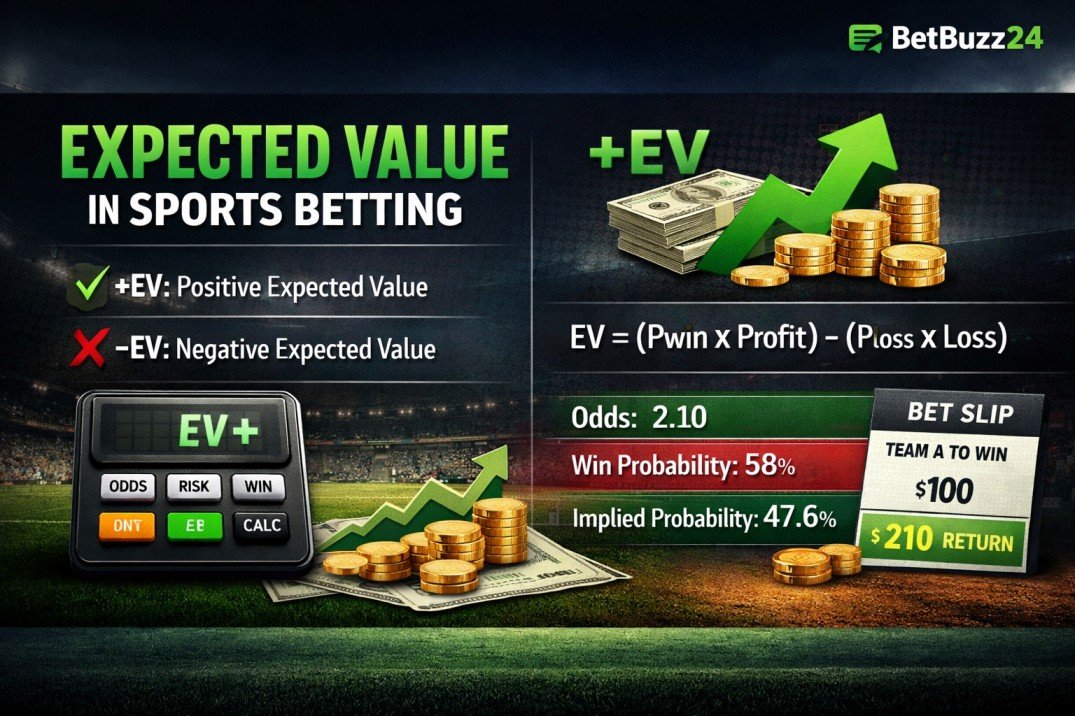
Assume the following inputs:
First, calculate implied probability from the odds:
Implied probability = 1 ÷ 2.10
Implied probability = 0.476 or 47.6%
Next, calculate potential profit if the bet wins:
Profit per win = (2.10 − 1) × 100
Profit per win = 1.10 × 100
Profit per win = $110
Loss probability:
Loss probability = 1 − 0.58
Loss probability = 0.42
Now apply the expected value formula:
EV = (0.58 × 110) − (0.42 × 100)
EV = 63.8 − 42
EV = 21.8
Expected value = +$21.80 per $100 wagered.
Because the result is positive, this bet has positive expected value based on the 58% probability estimate.
The calculation shows mathematically that the offered odds are higher than what the estimated probability justifies.
No. Positive expected value does not guarantee profit on a single bet.
Expected value reflects long-term expectation, not short-term certainty. Even if a wager has positive EV, it can still lose. In fact, losing streaks are completely normal, even when consistently placing mathematically sound bets.
The key idea is repetition under similar conditions. If you place one +EV bet, anything can happen. If you place hundreds of similar +EV bets over time, the average result should move in your favour based on probability.
This is why outcome-based thinking can be misleading. A winning bet does not automatically mean it was a good decision. A losing bet does not automatically mean it was a bad one.
Positive EV is about decision quality over time, not immediate results.
Even when bettors understand expected value, they often apply it incorrectly. Here are some common mistakes:
Overestimating true probability
The biggest error is assigning overly optimistic win percentages. If your probability estimate is inaccurate, your EV calculation becomes unreliable. Honest, disciplined estimation is essential.
Confusing short-term results with long-term expectation
A few losses do not mean EV “doesn’t work.” Expected value measures average outcomes over many similar bets, not single results.
Ignoring small edges
Many bettors look for large value gaps. In reality, consistent profitability often comes from small, repeatable edges rather than dramatic mismatches.
Relying only on bookmaker odds
If your probability estimate is influenced too heavily by the odds themselves, you are not creating an independent assessment. EV requires your own evaluation first.
Expected value is powerful, but only when applied with realistic probability estimates and consistent decision-making.
Once you have formed your own probability estimate, the next step is to test whether the wager qualifies as positive or negative expected value.
An EV calculator allows you to input three core elements: your estimated win probability, the bookmaker’s odds, and your planned stake. The tool then calculates the expected value of the bet and shows whether it is mathematically profitable over time.
Instead of relying on instinct, you can immediately see whether the edge is positive or negative based on your numbers. This removes emotional bias and turns the decision into a measurable comparison.
If the result shows positive expected value, the bet has a favourable long-term expectation. If it shows negative expected value, the price likely does not justify the risk.
You can use our Expected Value Calculator to quickly evaluate any wager before placing it.
Expected value only reveals its true impact through repetition.
Placing a single positive EV bet tells you nothing about immediate profit. However, placing the same type of +EV bet repeatedly under similar conditions allows probability to work in your favour over time.
Think of expected value as an average outcome across many trials. Some bets will win. Some will lose. What matters is whether the pricing edge exists consistently.
The more often you identify genuine value and avoid negative EV opportunities, the more the long-term results begin to reflect that advantage.
This is why disciplined bettors focus on process over outcome. The goal is not to chase short-term wins, but to repeatedly make mathematically sound decisions.
Expected value does not eliminate risk. It improves the quality of your decisions.
Expected value and return on investment (ROI) are related, but they are not the same.
Expected value is a forward-looking estimate. It tells you whether a bet is mathematically profitable based on your probability assessment and the odds offered. It measures decision quality before the result happens.
ROI, on the other hand, measures actual performance after bets are settled. It shows how much profit or loss you have generated relative to the total amount wagered.
In simple terms, EV predicts what should happen over time if your estimates are accurate. ROI reflects what has already happened.
A bettor can make positive EV decisions and still experience short-term negative ROI. Likewise, someone can have a short winning streak despite placing negative EV bets.
Expected value focuses on the process. ROI reflects the outcome.
Expected value is not a shortcut to guaranteed wins. It is a framework for making better decisions.
Instead of asking who will win, disciplined bettors ask whether the odds offered represent value relative to true probability. Over time, consistently choosing positive expected value opportunities creates a mathematical advantage.
If you want to evaluate your own bets instantly, you can use our Expected Value (EV) Calculator for Sports Betting to test whether a wager is +EV or -EV before placing it.
Expected value itself is a well-established concept in probability theory used across finance, statistics, and decision science. If you want to understand the broader mathematical foundation behind the concept, you can read more about expected value in probability theory on Wikipedia.
Betting without considering EV turns decisions into guesses. Betting with EV turns them into calculated risk assessments.
That shift is what separates long-term strategy from short-term luck.
Expected value in sports betting is the average amount you can expect to win or lose over time based on probability and odds. It helps you determine whether a bet is mathematically profitable rather than simply predicting who will win.
Positive expected value betting is profitable over many similar bets if your probability estimates are accurate. While individual bets can lose, consistently placing +EV wagers creates a long-term mathematical advantage.
A good expected value percentage in betting is any positive number. Even small positive EV percentages can become meaningful over time when applied consistently across many wagers.
Yes, you can win a negative expected value bet in the short term. However, consistently placing negative EV bets will lead to losses over time because the odds do not justify the risk.
Your probability estimate needs to be realistic and unbiased. Overestimating win chances is one of the most common mistakes and can turn what appears to be a positive EV bet into a negative one.
Expected value is more important than simply picking winners because profitability depends on price, not just outcomes. You can predict a winner correctly and still make a poor betting decision if the odds offer no value.
Expected value applies to all types of bets, including single wagers, parlays, and prop bets, as long as you can estimate the true probability and compare it to the bookmaker’s odds.
Parlays look exciting because they promise something simple and powerful: turn a small stake into…
If you’ve ever opened two sportsbooks and seen 2.40, 7/5, and +140 for the exact…
Hedge betting is placing a second bet against your original wager to reduce risk or…
A betting unit is a standardized way to measure your bet size using a percentage…
A value bet in sports betting is a wager where the probability of an outcome…
You place a $50 bet at 2.40 odds and the app shows a $120 payout.…
This website uses cookies.