Physical Address
304 North Cardinal St.
Dorchester Center, MA 02124
Physical Address
304 North Cardinal St.
Dorchester Center, MA 02124

Convert odds, remove vig, calculate fair odds, and check your edge instantly.
Convert American, Decimal, or Fractional betting odds into implied probability instantly. Enter the odds format used by your sportsbook to see the percentage chance reflected in the price. Use this calculator to evaluate market probability and compare it with your own projected estimate.
Implied probability is the percentage chance of an outcome occurring based on betting odds. It shows how likely the sportsbook believes an event is to happen.
Every set of odds contains built-in probability. Converting odds into percentage form allows bettors to evaluate pricing and compare the sportsbook’s estimate with their own projected probability.
Implied probability does not represent true probability. It includes the bookmaker’s margin, which is why market probabilities often exceed 100 percent.
Betting odds can be converted into implied probability using standard mathematical formulas. The formula depends on the odds format: American, Decimal, or Fractional.
For positive American odds:
Probability = 100 / (Odds + 100)
For negative American odds:
Probability = |Odds| / (|Odds| + 100)
Positive odds show how much profit you win on a 100 stake. Negative odds show how much you must stake to win 100. Converting them reveals the percentage likelihood implied by the sportsbook.
Probability = 1 / Decimal Odds
Decimal odds represent total return per 1 unit staked. Dividing 1 by the decimal value converts the price into percentage probability.
Probability = Denominator / (Numerator + Denominator)
Fractional odds show profit relative to stake. Converting them into percentage form reveals the implied probability built into the price.
The following examples show how different odds formats convert into implied probability.
100 / (150 + 100)
100 / 250
= 0.40
Implied probability: 40 percent
+150 odds indicate the sportsbook believes the outcome has a 40 percent chance of occurring.
110 / (110 + 100)
110 / 210
= 0.5238
Implied probability: 52.38 percent
-110 odds imply the outcome is slightly more likely than a coin flip.
1 / 2.50
= 0.40
Implied probability: 40 percent
Decimal 2.50 and American +150 represent the same underlying probability.
2 / (5 + 2)
2 / 7
= 0.2857
Implied probability: 28.57 percent
Fractional 5/2 implies the outcome has a lower likelihood than even-money pricing.
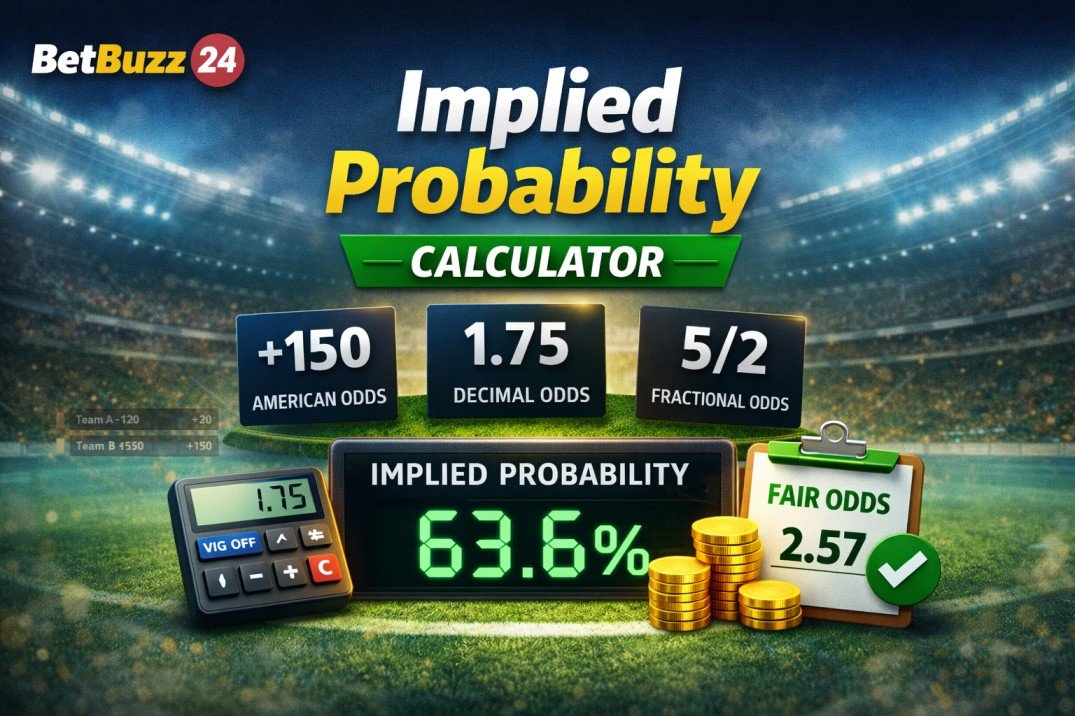
In most betting markets, the implied probabilities of all outcomes add up to more than 100 percent. This excess represents the sportsbook’s margin, commonly referred to as vig or overround.
Sportsbooks build margin into their prices to ensure long-term profitability. As a result, the combined implied probability of both sides of a two-outcome market typically exceeds 100 percent.
Team A: 52 percent
Team B: 52 percent
Total implied probability: 104 percent
The extra 4 percent represents bookmaker margin.
Because of this built-in margin, implied probability does not equal true probability. Removing the vig provides a clearer estimate of the market’s underlying expectation.
Removing vig adjusts market probabilities to eliminate the sportsbook’s margin. This produces a more accurate estimate of the true market probability.
In a two-outcome market, no-vig probability is calculated by dividing each implied probability by the total implied probability of all outcomes.
No-Vig Probability = Individual Implied Probability / Total Implied Probability
Team A implied probability: 52%
Team B implied probability: 52%
Total: 104%
No-vig probability for Team A:
52 / 104 = 0.50
= 50 percent
After removing the vig, each team reflects a true 50 percent market probability.
No-vig probability provides a cleaner baseline for evaluating betting value and calculating fair odds.
Implied probability allows bettors to evaluate whether a betting line offers value.
To assess value, compare the sportsbook’s implied probability with your own projected probability.
If your projected probability is higher than the implied probability, the wager may offer positive expected value.
Implied probability: 40 percent
Your projected probability: 48 percent
Difference: +8 percent edge
In this scenario, the sportsbook price undervalues the outcome relative to your estimate. Over time, consistently betting when your projected probability exceeds the implied probability is the foundation of value betting.
Implied probability is also used in expected value calculations, line comparison analysis, and market efficiency evaluation.
Probability can also be converted back into betting odds. This is useful when calculating fair odds based on your own projected probability.
Decimal Odds = 1 / Probability
Example:
Probability: 55 percent
0.55
1 / 0.55 = 1.82
Fair decimal odds: 1.82
If decimal odds are greater than 2.00:
American Odds = (Decimal – 1) × 100
If decimal odds are less than 2.00:
American Odds = -100 / (Decimal – 1)
Using the 55 percent example:
Decimal = 1.82
American ≈ -122
A 55 percent true probability corresponds to approximately -122 American odds.
Converting probability into fair odds allows bettors to compare their projected price directly with sportsbook pricing.
Implied probability in sports betting is the percentage chance of an outcome happening based on the odds set by the sportsbook. It shows how likely the bookmaker believes the event is to occur once you convert the odds into percentage form.
To convert betting odds to implied probability, use a formula based on the odds format. For positive American odds, divide 100 by odds plus 100. For negative odds, divide the absolute odds by absolute odds plus 100. For decimal odds, divide 1 by the decimal number.
Betting probabilities add up to more than 100 percent because sportsbooks include margin, also called vig or overround, in their pricing. This extra percentage ensures the bookmaker makes a profit over time regardless of the outcome.
No, implied probability is not the same as true probability. Implied probability reflects sportsbook pricing and includes margin, while true probability represents the actual likelihood of an event happening without bookmaker commission included.
Sharp bettors use implied probability to compare sportsbook odds with their own projected probability. If their estimate is higher than the implied percentage, the bet may offer value and potentially positive expected value over the long term.