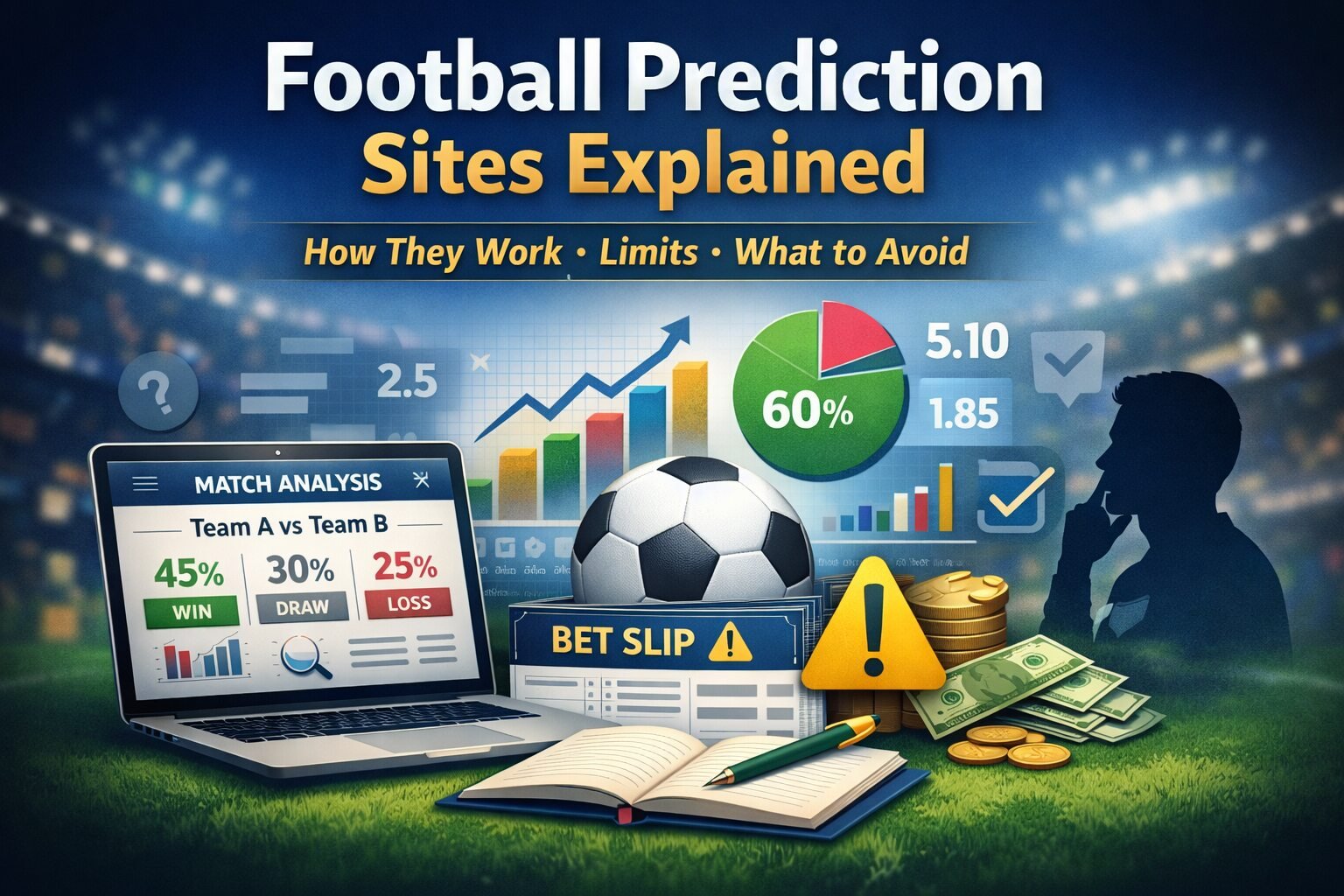
Football prediction sites are often misunderstood.
Most of them do not predict results in the way many users expect. They analyse historical data, team form, and market patterns, then present probabilities or suggested outcomes. None of this guarantees wins, and losses usually happen because users treat predictions as certainty rather than information.
This page does not rank sites by accuracy or promise better betting results. Instead, it reviews football prediction and analysis platforms based on transparency, methodology, and how clearly they explain their limits. Some provide curated tips, others focus purely on statistics and probabilities.
If you are looking for guaranteed outcomes, “sure wins,” or 100% accuracy, no football prediction site can offer that. If your goal is to understand how these platforms work, where they help, and when they should be avoided, this guide is designed for that purpose.
Football prediction sites do not “see” future results. They process information.
Most platforms use a mix of historical match data, team form, goal averages, head-to-head records, and sometimes betting market movements. Some rely on human analysis, others on statistical models or automated algorithms. The output is usually a probability, forecast, or suggested market, not a guaranteed outcome.
In practice, this means predictions are estimates, not instructions. A match predicted as likely to finish Over 2.5 goals can still end 0–0. Unexpected injuries, red cards, weather, and tactical changes regularly invalidate forecasts.
Understanding this distinction is critical. Prediction sites can help users interpret data and spot patterns, but they do not remove risk or replace independent judgment.
These football prediction sites were not evaluated based on wins, accuracy percentages, or betting returns.
Instead, the review focuses on factors a cautious user can verify before relying on any information:
Sites that rely heavily on hype, hide past data, or push urgency-driven messaging were excluded, even if they are popular.
The sites below are not listed in order of accuracy or performance.
They are included because they are widely used, regularly updated, and relatively clear about what they do and do not provide. Some focus on curated tips, others on statistics or probability models. None of them remove risk or guarantee results.
Each review highlights:
This approach is intended to help users choose tools that match their expectations, rather than chasing outcomes that prediction sites cannot reliably deliver.
Betensured presents itself as a curated football prediction platform. Instead of raw statistics, it focuses on ready-made picks for common betting markets, which reduces analysis effort for the user but also limits transparency into how each prediction is formed.
The site offers a mix of free predictions and optional paid access. Content is updated regularly and organised by match and market, making it easy to follow without prior technical knowledge.
What to know before using it
Because of this, Betensured works best as a reference tool rather than a decision-maker.
It may suit users who want structured suggestions and are comfortable applying their own judgment. It is less suitable for anyone expecting verified performance data or consistent outcomes.
PredictZ operates as a free football prediction and preview site. Its focus is not on tipping services or paid access, but on presenting match forecasts alongside basic statistical context such as recent form and league position.
Predictions are typically conservative and limited to common markets. The site avoids aggressive language and does not push upgrades or subscriptions, which keeps expectations relatively grounded.
What to know before using it
PredictZ is best treated as a starting point. It can help users understand likely match scenarios, but it does not replace deeper analysis or independent decision-making.
Forebet is a data-driven football prediction and analysis site. Instead of curated tips, it presents probability-based forecasts generated from statistical models using historical results, scoring patterns, and team form.
The site is more analytical than most prediction platforms. Users are shown percentages and projected outcomes rather than direct betting instructions, which shifts more responsibility onto interpretation.
What to know before using it
Forebet can be useful for users who are comfortable reading probabilities and building their own conclusions. It is less suitable for anyone looking for simplified picks or guided recommendations.
Zulubet focuses on quick, market-based football predictions, particularly both teams to score and over and under goals. The site is designed for speed, with predictions displayed in a simple list format that allows users to scan many matches at once.
There is limited context around each prediction. Percentages are shown, but deeper explanations or match previews are minimal, which means users need to apply their own judgment.
What to know before using it
Zulubet can be useful as a filtering tool for common markets, but it should not be relied on as a standalone source for decision-making.
Windrawwin is closer to a football data and trend analysis site than a traditional prediction platform. It places more emphasis on historical results, odds movement, and long-term team patterns than on ready-made picks.
Rather than telling users what to bet on, the site presents supporting information that can be used to build or reject a betting idea. This makes it more demanding, but also more transparent.
What to know before using it
Windrawwin is best suited for users who prefer researching trends and market behaviour. It is less helpful for those looking for simple, pre-packaged predictions.
Not all football prediction platforms focus on tips or picks. Some exist purely to provide data, probabilities, or modelling that users can interpret on their own. These sites are included for awareness, not endorsement.
They can be useful when combined with other tools, but they still do not remove uncertainty.
SoccerStats
SoccerStats provides league tables, scoring trends, and home and away performance data. It does not offer match predictions or betting advice, which makes it useful for users who want raw context without interpretation.
FootyStats
FootyStats focuses on goal-related probabilities such as over and under goals and both teams to score. The site visualises data clearly, but probabilities should be read as likelihoods, not expectations.
BetExplorer
BetExplorer tracks odds movement, historical results, and bookmaker data. It is primarily a research tool and requires users to draw their own conclusions from the information provided.
These sites add depth, but they work best as supporting resources, not as decision-makers.
Claims of perfect or guaranteed accuracy are one of the biggest warning signs in football prediction content.
Football matches are influenced by too many variables to be predicted with certainty. Injuries, red cards, tactical changes, weather, referee decisions, and late squad news regularly change outcomes in ways no model or tipster can fully account for.
Another issue is selective reporting. Some sites highlight winning streaks while quietly removing losses, which creates a misleading impression of consistency. Over time, variance evens out, and short-term success does not translate into reliable long-term results.
This is why phrases like “sure win,” “never lose,” or “100% accuracy” should be treated as marketing language, not evidence. Legitimate prediction and analysis sites avoid these claims entirely.
Football prediction sites can have value when they are used as reference tools, not decision-makers.
They are most useful for:
In these cases, prediction sites help users frame possibilities, not outcomes. They can support learning and research, but they do not reduce risk or replace independent judgment.
Football prediction sites are not suitable for everyone, and using them in the wrong way often leads to frustration.
They should be avoided if:
In these situations, prediction sites can reinforce poor decisions rather than improve them. They work best when approached cautiously and used alongside personal analysis, not instead of it.
Many users assume paid football prediction sites are more accurate because they charge money. In reality, payment changes how predictions are packaged, not how predictable football outcomes become.
Paid sites usually offer structure. This can include fewer matches per day, clearer market focus, or curated selections instead of long lists. For some users, this reduces noise and decision fatigue. It does not, however, remove uncertainty or guarantee better results.
Free prediction sites rely heavily on public data such as league form, goal averages, and historical trends. Paid platforms often use similar data but present it differently, sometimes adding human interpretation or filtering. The underlying information is rarely exclusive.
Another common misconception is that paid sites “protect” users from losses. They do not. Football remains unpredictable, and paid predictions are still affected by late injuries, tactical changes, red cards, and variance. Losses occur on both free and paid platforms for the same reasons.
What payment often changes:
What payment does not change:
For some users, paid sites feel more manageable and focused. For others, free sites provide enough information without added pressure. Neither option is inherently safer. The risk comes from over-reliance, not from whether a site is free or paid.
Football prediction sites are used worldwide, but how people rely on them differs by region. These differences are shaped more by betting culture and access than by prediction quality.
Africa
Prediction sites are widely used because they are easy to access and often free. Many users treat them as idea generators rather than full analysis tools. This popularity has also led to many low-quality sites making unrealistic claims, which increases the need for caution.
UK and Europe
Users are more likely to combine prediction sites with regulated bookmakers and statistical tools. Prediction platforms are often used alongside form guides, odds comparison sites, and probability models rather than as standalone decision-makers.
Other regions
In parts of Asia and North America, prediction sites are more commonly used as research tools. Data-driven platforms and statistical models tend to be preferred over curated tip-based services.
What stays consistent across regions
Access does not equal regulation. A site being popular in a country does not make it accurate, verified, or trustworthy. Regional usage reflects availability and habit, not reliability.
Football prediction sites are not suitable for everyone, and for some users they create more harm than value.
They should be avoided if:
In these situations, prediction sites often reinforce poor habits instead of improving decision quality. Stepping away from tip-based content can be a safer choice than trying to find a “better” prediction source.
Football prediction sites are information tools, not shortcuts to winning.
They can help users understand common markets, compare probabilities, and explore patterns in football data. What they cannot do is remove uncertainty, predict outcomes consistently, or guarantee results. Losses usually happen when predictions are treated as instructions rather than reference points.
Used cautiously, prediction sites can support learning and research. Used as a replacement for judgment or risk awareness, they tend to create false confidence rather than better decisions.
Football prediction sites can be informative, but they are not consistently accurate. Most rely on historical data and probabilities, which means predictions can fail due to injuries, red cards, or unexpected match events.
No. Any site claiming guaranteed wins or 100% accuracy should be avoided. Football outcomes are unpredictable, and legitimate prediction sites do not promise results.
AI-based sites process large datasets quickly and provide probabilities, but they are still limited by the same uncertainty as human analysis. They explain likelihoods, not outcomes.
Some free sites provide useful data and basic forecasts, but reliability varies by league and market. Free access does not mean inaccurate, and paid access does not ensure better results.
Relying on a single source increases bias. Most users benefit more from comparing multiple perspectives or using prediction sites as reference tools alongside their own analysis.
If you want to win at sports betting long term, you need more than predictions.…
Parlays look exciting because they promise something simple and powerful: turn a small stake into…
If you’ve ever opened two sportsbooks and seen 2.40, 7/5, and +140 for the exact…
Hedge betting is placing a second bet against your original wager to reduce risk or…
A betting unit is a standardized way to measure your bet size using a percentage…
A value bet in sports betting is a wager where the probability of an outcome…
This website uses cookies.